
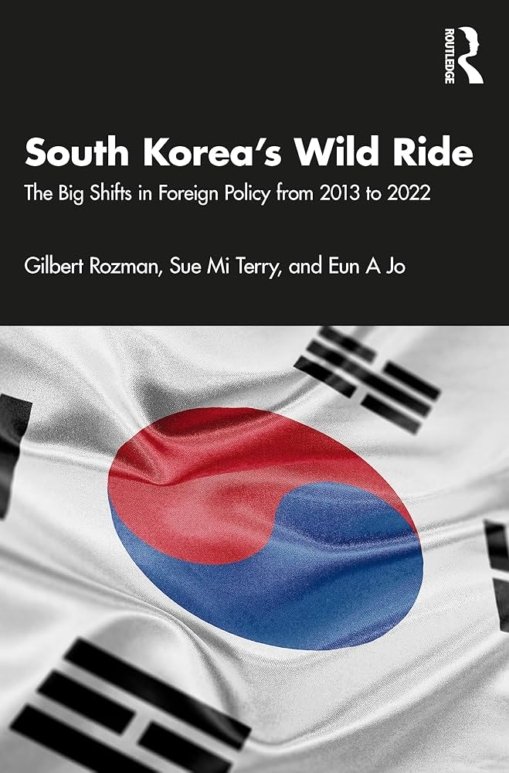
By: Gilbert Rozman, Sue Mi Teri, and Eun A Jo; Routledge Publications, Taylor and Francis Group, New York, 2024, 175 pages
ISBN: 9781032496405 (Hardcover); ISBN: 971032496399 (Paperback); ISBN: 9781003394792 (E-Book)
The book “South Korea’s Wild Ride: The Big Shifts in Foreign Policy from 2013 to 2022”, written by Gilbert Rozman, Sue Mi Teri and Eun A Jo, focuses on the tidal changes in the foreign policy of South Korea from 2013 to 2022. It addresses the presidential terms of Park Geun-hye, Moon Jae-in, and the transition into President Yoon Seok-yeol’s term in 2022. It focuses both on the external and domestic factors that impact Seoul’s foreign policy. The authors present a unique synthesis of Seoul’s foreign policy, blending the influence of North Korea, China, Japan, Russia and the US, with Seoul’s domestic politics, plagued by factionalism and a deeply divided yet highly aware society. Further, the book stresses the role of leadership in the discourse surrounding foreign policy, demonstrating how it changes depending on the party or ideology to which the President belongs. Given that South Korea is often called a “Swing State” due to the drastic shifts in its approach to geopolitical issues with the change in the ruling party, it is not too much of a stretch to term the turbulent period of 2013 to 2022 as a “wild ride” for South Korean politics and foreign policy.
The book is divided into three epochal parts but instead of these epochs being defined by the three presidential terms of Park Geun-hye (2013-17), Moon Jae-in (2017-2022), and Yoon Seok-yeol (2022 onwards), the authors have deliberately chosen the three epochs as 2013-15, 2016-19, and 2020-22. This choice highlights the fact that 2016 and 2020 were years when the existing foreign policy framework was inadequate to address the needs of Seoul, thus necessitating a reshaping of its foreign policy. It calls attention to a curious circumstance in that this trend took shape in the middle of the presidential terms of Park Geun-hye as well as Moon Jae-in, suggesting a shift in narrative in domestic politics as well. The authors also masterfully bring forth South Korea’s hope that it is the key to solving the issues of Northeast Asia, despite having little room manoeuvring their foreign policy in the face of the hostile environment of the region. They aptly identify the “three forces” that were the driving factors behind the shifts in foreign policy: “leadership changes, geopolitical factors, and a refocus on economic security.” [1]
Part I is entitled “South Korea in the Hot Seat, 2013 – 15” and it describes how Park Geun-hye started shifting the country’s foreign policy initiatives with respect to North Korea and the four great powers (the US, China, Japan and Russia), after succeeding President Lee Myung-bak in 2013. She established “a new conservative narrative” — countering the prevailing progressive one. This demonstrates the domestic political divide vis-à-vis foreign policy during this period. The book focuses on the evolution of “trustpolitik”, Park’s policy towards North Korea, from 2013 to 2015. Under this policy, Park had pushed for strengthening deterrence against Pyongyang while retaining focus upon building trust and having regular dialogues. This approach also entailed Park “courting China” to handle North Korea. However, by 2015 it was apparent that South Korea could not rely upon China to support it in addressing its core threat to national security.
Around this time, China, the US, Japan and Russia, were launching policy initiatives with Northeast Asia as an area of focus. The Park administration believed that these initiatives, combined with its own policy initiative, the Northeast Asia Peace and Cooperation Initiative (NAPCI) would create an opportune moment for South Korea to gain flexibility in its foreign policy choices. This flexibility in foreign policy choices would then enable Seoul to assert its influence in Northeast Asia, facilitating the desired shifts in regional dynamics. However, by 2015, all these calculations had failed. The authors also remark on Park’s sustained but ultimately futile attempts to garner support from the US and China for her policy initiatives towards North Korea. Finally, they introduce the element of historical legacy and its impact upon Seoul’s relations with China and Japan — especially the manner in which the administration’s thinking evolved over these three years with respect to both the nations.
Part II, entitled “South Korea’s High Stakes Diplomacy, 2016 – 2019”, starts with the Park government’s disillusionment after witnessing the failure of her foreign policy initiatives in 2015. This was most evident in the case of North Korea and China. This forced Park’s hand, and she had little option but to make necessary corrections. As a result, 2016 became the year of remarkable shift, as Park significantly altered her North Korea policy. This led to the installation of the US-made Terminal High Altitude Area Defence (THAAD) missile system in South Korea. This highlighted Park’s policy-tilt towards the US but invited condemnation from Russia, North Korea, and China. China’s boycott of South Korean businesses in response to this development led to the major brunt being borne by the Korean economy. 2016-17 also marked the beginning of President Donald Trump’s term, which was the catalyst in the USA’s disruptive approach towards Northeast Asia. The US-China rivalry had begun hardening in this period.
2017 also witnessed the impeachment of President Park, and the subsequent election of President Moon, who was the first president from the progressive faction after nine years of conservative rule in South Korea. Thus, it is not an exaggeration to look at 2016 and 2017 as years that marked a paradigm shift in South Korean foreign policy. The early part of Moon’s term was filled with suspicion or fear from established powers in Northeast Asia. He had pushed aggressively for engaging with North Korea again — and this resulted in several high-optic events in 2018 — the inter-Korean Summit, the two US-North Korea Summits, and many more. During this time, South Korea increasingly envisioned itself as a major economic power and sought to leveraging this for geopolitical gains in Northeast Asia. However, in 2019, the Moon administration was brought to earth in what might be termed a hard landing, when Kim Jong-un went back on his ‘promises’ of denuclearisation and recommenced missile testing, following a breakdown in talks with Trump. Russia, too, was becoming increasingly close to North Korea. As the country progresses through the current year (2024) this is fast becoming a point of major concern for Seoul.
Part III, entitled “South Korea Sobers up, 2020 – 2022”, describes how the period between 2020 and 2022 became yet another watershed moment for South Korean foreign policy. It not only marked the beginning of President Yoon Seok-Yeol’s term but also witnessed unprecedented levels of provocations by North Korea. South Korea and the US struggled to find an effective solution to deal with this situation. The authors note that due to global attention being focussed upon the Russia-Ukraine war, Seoul was unable to mobilise support from the international community terms of dealing with Pyongyang. COVID-19 was another source of major disruption for the world and Seoul was no exception to its geopolitical impact. In 2022, although Seoul’s relations with Russia tanked due to the Ukraine war, its relations with Japan improved significantly. Relations with the US, too, gained momentum as President Yoon was in favour of establishing an “Indo-Pacific Framework”. Yoon is treading carefully with China. His approach with Beijing brings traces of ambiguity in Seoul’s Indo-Pacific strategy. As the authors have noted, “the years 2020 – 22 revealed both the changing ambitions and lingering limitations of South Korean foreign policy.” [2]
The failure of the authors to extensively address the New Southern Policy (NSP) and the New Northern Policy (NNP), which were introduced in 2017, and later evolved into Seoul’s Indo-Pacific Strategy (2022), is surprising. Russia, Central Asia and East Europe are the areas of focus for NNP, while Southeast Asia and India are the areas of focus for NSP. Both these policies aimed at expanding the reach of South Korea’s foreign policy beyond Northeast Asia. They also signify a shift in the foreign policy, which is something that deserved more attention in the book.
The authors’ compendious writing style allows for the book’s modest length without compromising its quality and substance. They have flawlessly encapsulated the complex nature of Northeast Asian geopolitics, inter-Korean relations, Korean foreign policy, and domestic politics. While some readers may find the prose dense, demanding much time and attention, it is a must-read for all who are interested in South Korea’s foreign policy and the regional dynamics of Northeast Asia.
******
About the Reviewer:
Ms Yukti Panwar is a Junior Research Associate (JRA) at National Maritime Foundation (NMF), New Delhi, India. Her research focuses upon the manner in which the maritime geostrategies of India are impacted by those of Japan and South Korea. She also delves into the larger context of Indo-Pacific and the burgeoning challenges within this region. She can be reached at ea1.nmf@gmail.com .
Endnotes:
[1] Gilbert Rozman et al, South Korea’s Wild Ride: The Big Shifts in Foreign Policy from 2013 to 2022 (New York: Routledge, 2024), 13.
[2] Gilbert Rozman et al, South Korea’s Wild Ride: The Big Shifts in Foreign Policy from 2013 to 2022, 169.


Leave a Reply
Want to join the discussion?Feel free to contribute!