
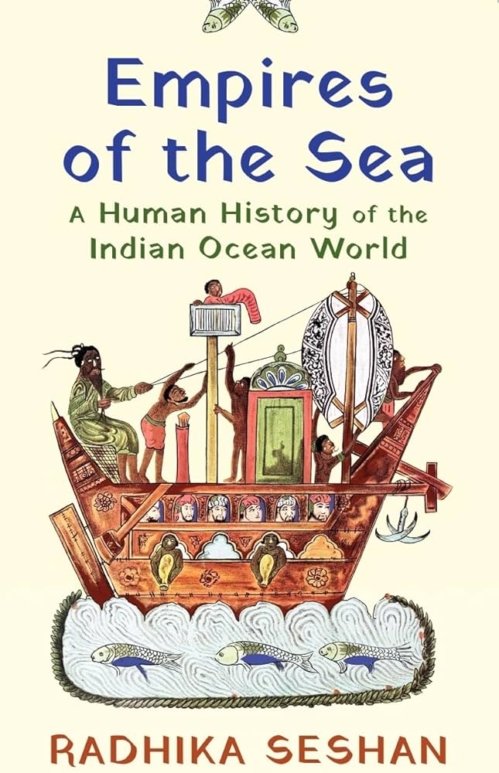
Radhika Seshan. Pan Macmillan Publishing India Pvt Ltd, 2024. 236 Pages, ISBN: 978-93-90742-50-9, Rs 357 (Paperback)
Radhika Seshan’s book, “Empire of the Seas: A Human History of the Indian Ocean World”, breaks new ground in the ongoing process of re-evaluation of Indian history, in that it attempts to augment this process through a specifically “maritime” lens rather than the usual land-centric ones. Refreshingly, the author places the seas at a central position in the story of human development and, thereby, of human history, even the oceanic space covered by the author in this particular book is contextualised to the Indian Ocean. It has a total of six chapters, which detail, through a progressive timeline, India’s maritime history. The author’s research is theoretically grounded, and she seeks to conduct her inquiry in a largely subjective manner, although her work is, of course, supplemented by objective evidence. This approach is well chosen and is quite capable of supporting the seminal argument that she seeks to justify.
The book begins by looking at ‘water’ as a key physical element, and shedding light upon its association with human history. However, the theoretical question that the author explores is whether it is possible for ‘water’ (as an element), particularly in context of the Indian Ocean, to have a history of its own that could be traced backwards though time. In the introduction of the book, the author delves into a myriad of subjects that outline the role of ‘water’ and the various ways of projecting its history. The history of water, Seshan contends, can be viewed as a mix of geographical realities married to human ability, imagination, and artistry. The lifestyle of coastal communities — the means by which they navigated these waters and the craft borne of artistic imagination — amalgamate the physical and representative worlds. This, according to the author, is because the presence of ‘water’ is both tangible and intangible.
A crucial point that the book brings out is the central role played by the political imagination of human beings, and its resultant manifestations through human linkages with the sea. It strives to highlight a point in time when human association with the seas began to develop into territorial attachment and grew sovereign aspirations, which have led to the incremental “subordination of the seas”. The human ambition of controlling and owning a medium as fluid as water borders upon hubris and this is a particularly intriguing point that Seshan makes. She also prompts that the real gap (beyond the political imagination/connection) in the study of human engagement with the seas lies in the physical aspect, that is, an understanding of the literal affinity of the masses with this element.
The first two chapters attempt to define the geographical layout of the Indian Ocean, while outlining the extent of interaction, and the native understanding and indigenous innovation which developed as a result. The author brings out the connection between ‘geography’ and ‘history’ as disciplines, and the subsequent effect of this connection upon culture. The author then delves into the diverse nature of human linkages to the Indian Ocean and their influence on the wide corpus of knowledge. She posits that a host of valuable knowledge developed as a consequence of a strong cultural foundation, one that rationalised the lifestyle which came about as a result of physically experiencing the seas as an important part of the human experience and evolution. Seshan comes up with rather unique markers in time, which begin from the Harrapan civilisation, then move onto trade with the Romans, and finally encompass the period defined in “Sangam” literature. Varied evidence of trade (such as from seals, sculptures, and trade routes) plays a central role via which maritime activity is traced throughout this segment of the book. The subject of ‘trade’ also lends itself to the subsequent chapter, which explores the busy maritime trade networks that were spread across the region well before the arrival of the Europeans.
Another key point that the author highlights is the overlap between the “worlds of water and land”, wherein she extends the maritime world into the hinterlands of India, nudging the reader to move beyond just the ocean and the coast. The author relies on a great variety of sources aside from archaeological evidence, and these include religious rituals and performances, and regional literature. Importantly, Seshan does not shy away from consciously addressing gaps in colonial historiography. In the third chapter, the author essentially brings forth the idea that with the arrival of European seafarers, the erstwhile expansive geographical spread and the wide-ranging functional scope of maritime activity in the Indian Ocean began to shrink and this continued until both were ultimately subsumed within the conceptual bounds of European colonial rule. Seshan contends that an authentic collective or general affinity to the seas, therefore, lasted until the thirteenth century, after which this generic understanding, and the symbiotic relationship between indigenous peoples of the Indian Ocean and their oceanic environment began to dissolve and become fragmented. It is the thirteenth century onwards, the author opines, when European imagination of the “East” began moving towards realisation. In the fourth chapter, the book addresses the pre-European networks that existed in the Indian Ocean — a network that was rendered by the European arrival. Her review of these pan-oceanic networks then gives way to the segment that focuses upon the arrival of the Europeans. Interestingly, Seshan challenges the conventional wisdom that holds that the success of the Europeans was due to the lack of knowledge of the sea on part of the Indian kingdoms (and other subordinate geopolitical entities), stating this to be both factually and historically incorrect. Although she herself does not, in the opinion of this reviewer, address herself adequately to this assertion and its defence, Seshan nevertheless performs an important service in not merely identifying a new doorway to historical knowledge but in opening it for other researchers and historians to explore this pathway and in so doing, separate shibboleths from facts.
Seshan utilises her fifth chapter to underscore additional key points of her research narrative as she details the clash of thought and change of perception surrounding the sea itself once the Portuguese begin establishing dominance by claiming control of the coast and the sea. This was, in fact, the initial introduction to the concept of the sovereignty of the seas. The final chapter highlights how the resulting political instability and establishment of colonial rule changed the state of the Indian Ocean region forever.
Through this book, the author has successfully put forth a humanistic perspective in line with its inquiry into the maritime aspect of Indian history. Seshan deals with an extensive timeline and varied sources simultaneously — which taken together, become prone to subjective findings and conclusions — making the nature of the text rather eclectic. Since each chapter carries a theoretical question (often addressed through multiple lines of inquiry), there is a seductive flow to the content. This essentially means that while the content is packed with an impressive amount of objective evidence, its flow relies extensively upon its theoretical grounding, thereby generating a nuanced interplay of style and purpose of writing. In conclusion, it must be acknowledged that the author has, with competence and style, addressed an important gap in the understanding of the maritime history of the Indian Ocean. Each theme explored through different chapters in the “Empire of the Seas: A Human History of the Indian Ocean World” generates an invaluable marker for further research. This set of pointers differentiates the book from many other more pedestrian and more Eurocentric narratives, providing the reader with a set of gems to gather at will.
******
About the Author
Ms Priyasha Dixit is a Research Associate of the National Maritime Foundation. She holds an MA in Law, Politics and Society from Dr B R Ambedkar University, Delhi (AUD). She got her Bachelors Degree in History and Political Science from the University of Delhi. Her current research focuses upon matters pertaining to maritime history. She can be reached at indopac8.nmf@gmail.com.


Leave a Reply
Want to join the discussion?Feel free to contribute!