
The resilience of submarine communication cables — which are integral to international connectivity — is receiving increasing attention at the international level.[1] Increasing the resilience of submarine communication cable systems would involve, inter alia, introduction of redundancies, i.e., introducing greater number of cables with greater carrying capacity, as well as increasing the capacity-of and capability-in prompt maintenance and repair of cable systems.[2] Given the cost factors associated with the installation of more cables with greater carrying capacity — estimated cost for a cable system can range from US$ 2.0 million to US$ 6.8 million per kilometre[3] — prompt repair capabilities provide a more effective method of introducing resilience in the cable system. Moreover, it allows for a shorter turnaround time no matter the cause of the initial disruption. This also reduces the loss suffered from cable disruptions, which includes costs for routeing data through different cables, and the losses accumulating from slower or disrupted data connectivity. This is particularly significant for India, 7.5% of whose GDP comes from the IT/Business Process Management industry.[4]
On an average, there are 150 cable faults each year[5] and as of 2015, the average time for cable repair in Indian maritime zones was 50 days.[6] As the bulk of global data travels through submarine communication cables, disruptions may have an economy-wide impact and even affect national security at larger scales.[7] Therefore, going forward, effective maintenance and repair capacity and capability is essential for cable resilience. This article speaks to the Ministry of Communications, Ministry of External Affairs, Ministry of Ports, Shipping and Waterways, and the National Security Council Secretariat, Government of India. It first describes the process, mechanism, and challenges to submarine cable repair; and then explores how India’s international engagements can be leveraged to enhance India’s capacity-of and capability-in submarine cable repair.
Process of Cable Repair
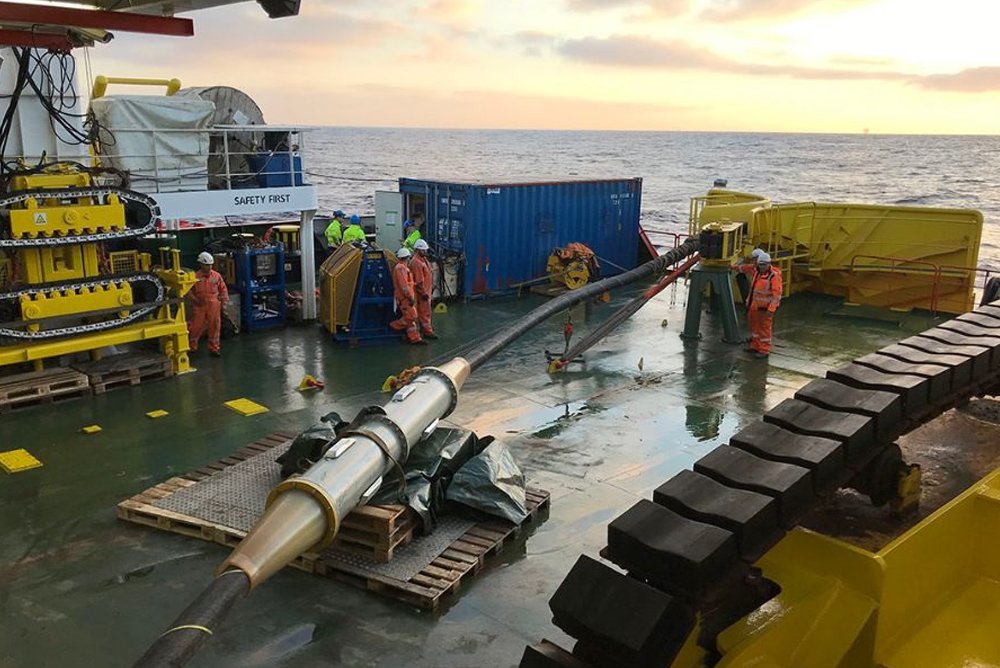
The process of cable repair generally begins with identifying the site of the fault.[8] Thereafter, a cable repair vessel with a specialised crew and repair equipment proceeds to the identified fault location. A large cutting grapnel is towed along the seabed until the cable is caught which is then raised and cut. The portion to be repaired is brought aboard and the other end hooked to a buoy.[9] Once the cable is repaired/or spare cable is attached, the cable is then joined together to the piece previously buoyed off and the final splice is lowered back to the seabed.[10] At shallower depths, remotely-operated vessels (ROV) equipped with cameras and actuators are deployed for fault detection, cable retrieval (as at these depths the cables are generally buried), and final (post-repair) cable reburial.[11] Therefore, this process requires a ROV, a cable repair ship, spare parts, and a highly specialised crew, each of which constitutes scarce and expensive resources. Recently, Moyle Interconnector Ltd has tested an in-situ repair method at 25 m depth without requiring the retrieval of the cable to the surface.[12]
Current Challenges
The submarine cable maintenance and repair industry faces a severe capacity-and-capability crunch. Globally, as of 2022, around 60 maintenance and repair ships exist for communication cables, a bulk of which are in old condition and close to retirement.[13] The cable repair vessel market has been segmented on grounds of cable-carrying capacity, water depth, and end-use.[14] On the basis of carrying capacity they are below 1000 tonnes, 1000-3000 tonnes, 3001-5000 tonnes, 5001-7000 tonnes, and above 7000 tonnes.[15] For non-armoured cables the carrying capacity of a cable ship is determined by the metric capacity of its cable tanks.[16]
Since, cables can be both, telecom and power cables, the end-user could vary from the offshore oil and gas industry, offshore wind farms, and the telecom sector. Therefore, there is a division of investment in each of these sectors. Moreover, there has been a profound increase in the number communication cable projects without a corresponding increase in a maintenance and repair fleet.[17] New ships require steep investments (above US$ 100-150 million), which are ever increasing due to soaring input costs.[18] Hence, the current practice frequently involves retrofitting ships for the purpose of cable repair.[19] A notable recent example is the acquisition by SB Submarine Systems Company Ltd — a submarine cable installation and maintenance company based out of Shanghai, China — of an offshore construction vessel originally built for servicing the oil and gas industry.[20] This vessel was then retrofitted for submarine cable laying and maintenance operations and inducted as the CS Fu Tai within a year — July 2021 (bought) and February 2022 (inducted).[21]
More problematic is the lack of capabilities, i.e., a specialised and trained crew.[22] Lack of awareness about the industry, its small and competitive size, national security concerns, and the time required to train people in cable repair, all contribute to the low recruitment and availability of skilled personnel.[23]
Even for ships currently in service, the ownership structure is highly skewed to a handful of private companies.
The following table lists a few repair vessels by ownership, flag state registration, and base port:[24]
| Country | Base Port to Number of Vessels | Total Number of Vessels Flag-Registered | Ownership (Number of vessels) | Other Base Ports (Number of vessels) |
| France | 4 | 9 | ASN Marine/Alcatel (4)
Orange Marine (4) OMS Group (1) |
Cape Town (1)
Cape Verde (1) Worldwide (3) |
| Marshall Islands | Nil | 6 | SubCom LLC (6) | Baltimore, USA (4)
New Caledonia (1) Taiwan (1) |
| Panama | Nil | 3 | S.B. Submarine Systems Co. Ltd (3) | Wujing Cable Depot, Shanghai, China (3) |
| Indonesia | 3 | 4 | OMS Group (3)
PT Limin Marine & Offshore (1) |
Batam, Malaysia (1) |
| Japan | 3 | 4 | NTT World Engineering Marine (1)
KDDI Cableships & Subsea Engineering (3) |
Worldwide (1) |
| Singapore | 2 | 4 | ASEAN Cableship Pte Ltd. (3)
Global Marine Systems Limited (1) |
Colombo (1)
Subic, Philippines (1) |
| United Arab Emirates | 5 | 5 | E-Marine | – |
| United Kingdom | 3 | 5 | Global Marine Systems Ltd. | Curacao (1)
Canada (1) |
| United States | 5 | 1 | SubCom LLC | – |
|
Table 1. Global Cable Repair Vessels Source: Compiled by Author from ICPC, “Cable Repair Ships of the World” |
||||
It is, therefore, evident that cable repair ships are concentrated with a few corporations and in a few base ports. We see that France, Japan, the UAE, the USA, and the UK, lead in cable repair capacity globally. Unfortunately, India does not feature in the list, with not a single cable repair vessel being either Indian-flagged, Indian-owned, or India-stationed. With India’s growing data needs, and with India acting as the hub for east-west connectivity, having effective repair capabilities is important not only for India but also for the wider Indian Ocean region.[25]
In current practice, the maintenance and repair of submarine communication cables is a shared service wherein the resources within a defined operational area are shared between cable owners.[26] This happens in two ways: Traditional Club Agreements and Private Maintenance Agreements.[27] In the former, the agreement conditions and prices are linked with all the participating cable owners, while in the latter, negotiations and agreements are done on a bilateral basis between the ship operator and the cable owner.[28] There are six traditional maintenance agreements and four private maintenance agreements, with each agreement corresponding to a particular geographical area that is supported by vessels and facilities available in that particular zone, as depicted in Figures 1 and 2 respectively.[29]
India is within the Southeast Asia and Indian Ocean Cable Maintenance Agreement (SEAIOCMA) zone. This zone is primarily serviced by the Global Marine Systems Ltd and the ASEAN Cableship Pte Ltd (ACPL).[30]
ACPL (of which Singapore Telecom is a shareholder) owns the ship, which is based at a cable depot in Galle in Sri Lanka. This cable depot is owned by the Galle Submarine Cable Depot Pvt Ltd, which is a joint venture between SLT-Mobitel, Sri Lanka, and the Indian Ocean Cable Ship Pte Ltd (IOCL). IOCL, in turn, is a joint venture between Singapore Telecom and Orange Marine of France.[31] This demonstrates how Singapore Telecom’s investment expands the operations of ACPL and benefits Sri Lanka through capacity building.
Global Marine Systems has a ship stationed in Subic, Philippines, to service the SEAIOCMA. On the private agreement front, which is on a bilateral basis, the Abu Dhabi-based firm, E-marine, is the predominant supplier of repair services in India.
Even though such arrangements are in place, the average response time for repairs and associated costs are substantial. The average response time for E-marine in Indian waters is 3-5 months, while that for SEAICOMA is 4-5 months.[32] Prolonged response times can be attributed to the travel time between depot to the repair site; import and export clearance procedures; and naval, customs, and crew member clearance.[33] However it must be noted that shallow water repairs, i.e., those undertaken in depths less than 15 m, are done through local contractors who have available the barges, permissions, and the knowledge of local conditions.[34] It is this shallow water repair that is even more vulnerable and may take up to a year due to the unavailability of a requisite cable ship, jointing equipment, and skilled personnel in India.[35]
While cable redundancy within the Indian system can withstand the relatively infrequent disruptions to cables, any intentional sabotage, which may affect multiple cables simultaneously, will leave India’s digital connectivity extremely vulnerable. This threat is accentuated during times of conflict — especially prolonged conflict — where deliberate damage to submarine cables is likely to be used as part of planned operations, and to counter which, prompt restoration is crucial. Foreign dependence for cable repairs in times of conflict is a major vulnerability to India’s communications architecture. Times of conflict may trigger force majeure clauses of cable maintenance agreements rendering them unenforceable on the basis non-performance. The mechanism involving determining repair priority, clearances for foreign-crew and foreign-flagged vessels, the willingness of ship operators/crew to operate in contested waters, and likely-to-soar insurance premiums are additional issues that will arise during conflict.[36] For India, submarine cables are increasingly more important for internal connectivity, especially for its island chains, i.e., the Andaman and Nicobar Islands, and Lakshadweep Islands.[37] Therefore, having indigenous capacity and capability for repair in both shallow and deep-water is essential, especially for times of conflict.
Recognising this vulnerability the United States, through legislation in 2019, established a Cable Security Fleet.[38] It essentially seeks to establish a fleet of active, commercially viable, cable vessels that would be privately-owned and US-documented to meet national security requirements.[39] Such vessels, on application — and after the execution of an Operating Agreement — would be inducted into the fleet, for which USD 5,000,000 (Five Million) would be paid by the US government to the ship operator as a stipend.[40] In addition to the Operating Agreement, a Contingency Agreement would also be executed between the US government and the operator, stating that the operator will make the vessel, including all necessary resources to engage in cable services available upon request.[41] In this manner, a set of US-flagged, US-crewed vessels is available to the United States for prompt cable repair, which is treated as a national security requirement. Such is the importance of prompt cable repair.
This fact has not been lost on the Government of India. The Telecom Regulatory Authority of India (TRAI), in its Recommendations on Licensing Framework and Regulatory Mechanism for Submarine Cable Landing in India, has a dedicated segment on submarine cable repair where these issues are highlighted and addressed with potential solutions having duly evolved after industry-stakeholder consultations. The essence of the recommendations made by the TRAI are:
- Constitute a government committee to recommend a variety of financial viability models for Indian Flagged Cable Repair Vessels.
- Approach repair ship operators in the Indian subcontinent to persuade them to relocate and reflag their repair vessels at suitable Indian ports as per requirement.
- Incentivise and facilitate the setting-up of cable depots on the east and west coast of India, with Special Economic Zone (SEZ) status, for storing submarine cable equipment and as a base for any future cable repair ships.
- Review clearance and permit requirements for submarine cable repair activities in India.
One aspect which features in the analysis but not in the final recommendations is the possibility of retrofitting vessels for cable repair. The document acknowledges that the facility to retro-modify a general-purpose vessel exists in India, although that ability had been mentioned in the context of fitting survey equipment.[42] Such retrofits for cable repair, too, could achieve the desired results. As seen in the case of CS Fu Tai, an offshore construction vessel was acquired and converted into a cable repair vessel. Since cable repair vessels need not to be particularly large — with cable capacity up to 1000 tonnes — a whole host of vessels may be acquired for addition to the cable repair fleet. There is also a strong commercial case for acquiring such vessels as the cable laying and repair industry (both power and telecom) is forecasted to grow at a CAGR of 9.88%, with the largest segment being for cable repair.[43]
In addition to these recommendations — which are important to establish the entire ecosystem of submarine cable repair in India — international cooperation as a tool to improve cable repair capacities and capabilities needs to be explored. Since India does not currently possess either the capacity or capability for cable repair, leveraging current partnerships and investments during peace time could reap rich dividends during conflict. International cooperation can be used in addition-to and in support-of the internal regulatory and commercial measures recommended by the TRAI.
International Partnerships for Cable Repair
Cable resilience is interconnected. Cable connectivity is structured in such a way that each cable serves as a restoration/alternative path for the other.[44] Hence, disruptions to one make the others increasingly more vulnerable. Since cable protection is increasingly becoming a matter of concern for States (as opposed to being a purely commercial issue), the issue of cable protection is more likely to be welcome in dialogue and cooperation between States.
It is posited that cooperation can proceed on three fronts:
- Expediting the permits and clearance processes for specified States on an agreement basis.
- Joint Ventures between Indian and foreign telecom entities to jointly build, acquire, or retrofit cable repair vessels.
- Development of a skilled global workforce for cable repair through training facilities and opportunities. This aspect is particularly crucial to focus on and does not find mention in the final recommendations of the report even though it formed a fleeting part of the discussion.
A strong example of regional cooperation for cable protection is found between ASEAN member States (AMS).[45] The ASEAN ICT Masterplan 2020 includes (in Action Point 4.1.1) the objective to promote cooperation to strengthen the resilience and repair of submarine cables by “developing a framework among all AMS to expedite repairs of submarine cables within their waters by minimising permit requirements and costs”.[46] This includes developing a template for Service Level Agreements for submarine cable repair.[47] Here we see an attempt at setting the commercial parameters of an activity by State-level agreements. To this effect, non-binding guidelines, called the ASEAN Guidelines for Strengthening Resilience and Repair of Submarine Cables, have been finalised that seek to streamline information requirements for application of permits, and to establish best practices for expediting application approvals.[48] In fact, the ASEAN Cableship Pte Ltd. (ACPL) referred-to earlier, is a joint venture — set up by the ASEAN Telecommunications Authorities — of the public telecom companies of Thailand, Philippines, Indonesia, Brunei, Singapore, and Malaysia.[49] It owns three cable repair vessels and has become one of the leading companies in the cable maintenance industry, including being an active player in the SEAIOCMA Maintenance Zone.
With ACPL already having a presence in Sri Lanka, a joint venture can be conceived with this corporation on jointly acquiring a vessel, retrofitting it in India as a cable repair ship, and stationing it on India’s east coast. This arrangement benefits India due to the acquisition of a vessel and experience in retrofits for cable repair vessels. Such arrangement has benefits to ACPL, too, as India may be able to provide a cost-effective quality retrofit, and increased business for the new vessel from Indian cable operators. Such an engagement could proceed either in an India-ASEAN interaction, or even bilaterally with Singapore or Indonesia, both of which possess experience in cable repair vessel design and operation.
This vessel, if based on the east coast of India will be able to service the rest of the Bay of Bengal littorals effectively, too. Similarly, additional west coast-based vessels would also be able to promptly repair submarine cables of island States in the Indian Ocean, and thus will not only have an available market but will also exert a positive influence in the region.
There are also other existing mechanisms — of which India is a part of — under which such cooperation can take place. Most notable is the “Quad Partnership on Cable Connectivity and Resilience”, which has within its scope, the strengthening of cable systems in the Indo-Pacific by drawing on the world-class expertise of several Quad countries “in manufacturing, delivering and maintaining cable infrastructure”.[50] Therefore, cable maintenance is already a part of the Quad programme. Drawing from this initiative, Australia has launched an Indo-Pacific Cable Connectivity and Resilience Program, which will “commission technical and policy research, share best-practice policy frameworks and provide technical assistance to the Indo-Pacific”.[51] Additionally, the United States has pledged US$ five million for technical assistance and capacity building on security of undersea cable systems.
India, hence, could utilise these programs to develop capacity and capabilities in subsea repair on all three fronts that have been listed earlier. Such cooperation could take the form of the joint purchase of offshore vessels, and the licensing of cable repair vessel designs from major cable repair vessel operators in Japan and USA, which can then be used for retrofitting in India. This way, vessels would be available for India and in India, which also provides a geostrategic advantage for the Quad Member countries to repair cables in the Indian Ocean, such as the Oman Australia cable connecting Australia, Diego Garcia, and Oman.[52] Additionally, the establishment of crew training centres, which can be fed by the talent from India and QUAD member countries, could address the shortage of skilled workforce. Such engagement may be undertaken on a bilateral basis between India-USA and India-Japan, too.
In a similar vein, the India-France-UAE trilateral also offers exciting possibilities. As evident from Table 1, France and UAE, between themselves, have 14 (fourteen) cable repair vessels which represents 23.3 per cent of global cable repair vessels. Therefore, France and UAE possess significant capacities and capabilities in cable repair, which could be leveraged through the trilateral. However, unlike the QUAD grouping, protection of submarine cables or critical infrastructure does not feature within the initial objective of the trilateral, which focuses primarily on clean energy, climate protection, defence, and technological cooperation.[53] Nevertheless, the strategic nature of submarine communication cables and their underlying security imperative makes cooperation in their resilience a natural inclusion within the scope of technological cooperation of the trilateral. The intent of joint development and co-production in the defence sector, and encouragement of technology transfer and entrepreneurship, bodes well for collaboration in cable repair and maintenance. Moreover, the importance of India for east-west connectivity both in strategic and commercial terms can hardly be overstated. Any cable planned between Europe and Southeast Asian countries will necessarily land in India.[54] Additionally, the availability in India of a skilled workforce and the requisite ecosystem necessary for ship building will create a mutually beneficial partnership.
The nature of collaboration may follow the same three lines of effort as indicated above. While the long-term objective may involve joint production of cable repair vessels ab initio, in the intervening period, transfer of technical expertise of cable repair ship design and operation will be hugely beneficial. As mentioned above, a bilateral engagement may be considered between India and France and/or India and the UAE, for this purpose. The former may be more likely to succeed as E-marine (which is a UAE-registered company) has competing commercial interests in the region as opposed to France. That said, however, French presence in the Indian Ocean has greater strategic overtones as opposed to the UAE for whom commercial interests may well be higher. Thus, the UAE may be interested if a more lucrative commercial arrangement is achieved, such as making the vessel available to E-marine for commercial contracts it executes at a subsidised rate.
Additionally, ROV design and production presents an additional spoke on which this partnership may be developed. India has been investing in the research and development of ROV capabilities. The Ministry of Science and Technology, and the Ministry of Education have funded an Indian Institute of Technology (IIT) Bombay project on the design and development of underwater ROV for inspection and surveillance for applications such as pipeline inspection, which will be designed and produced by Larsen & Toubro Ltd.[55] Moreover, Planys Technology, which is an IIT-Madras incubated start-up, indigenously manufactures ROVs and is “first in the world to offer ROVs integrated with advanced sensing and diagnosis tools”.[56] Therefore, India has demonstrable capability in ROV production. Since ROVs are an important component for cable laying and repair, a joint venture for upscaling ROV design and production for cable repair may be a mutually beneficial and hence enduring partnership.
Conclusion
The foregoing arguments demonstrate that it is extremely important that the capacity and capability for cable repair are acquired by India. The imperative is much greater for times of conflict than it is for times of peace. The recommendations made by the TRAI offer an excellent starting point and are necessary to build the entire ecosystem of cable repair in India. India’s international engagements can, indeed, be leveraged — either through bilateral or multilateral means — to develop and enhance India’s capacities and capabilities in submarine cable repair. This capacity and capability can then, in turn, be leveraged to India’s advantage in its own regional engagements. Such engagements may take the form of transfer of technical expertise in cable repair vessel design, joint acquisition of an offshore vessel for retrofitting in India, development of training centres for cable repair crew, or ROV design and production. Each of these segments affect the resilience of cables not only in India but also globally given the interconnected nature of submarine telecommunication cables. India is, therefore, well-placed to lead such an initiative.
Endnotes:
[1] European Commission, “Commission Recommendation on Secure and Resilience Submarine Cable Infrastructure”, (Brussels: European Commission, 2024) https://digital-strategy.ec.europa.eu/en/library/recommendation-security-and-resilience-submarine-cable-infrastructures
[2] Ibid p7
[3] “Submarine Cable Systems Market Size, Share & Industry Growth Analysis Report” (MarketsAndMarkets, 2022) https://www.marketsandmarkets.com/Market-Reports/submarine-cable-system-market-184625.html
[4] Nicholas Kazaz, “Subsea Cable Damage Claims: The Legal Approach” Submarine Telecoms Forum, March 2020 https://www.hfw.com/downloads/001932-ARTICLE-SubTel-Forum-April-2020.pdf
Also See: Shangliao Sun, “Contribution of Indian IT-BPM Industry in GDP of India FY 2009-2023”, Statista September 18, 2023, accessed 15 April 2024
[5] International Cable Protection Committee, “Message from the International Cable Protection Committee: Recent Events Involving Submarine Cables in the Red Sea”, ICPC Press Release, last modified 28 February 2024 https://www.iscpc.org/news/
[6] Anjali Sugadev, “India’s critical position in the global submarine cable network: an analysis of Indian law and practice on cable repairs”, Indian Journal of International Law, 23 Feb 2017
[7] Soham Agarwal and Vice Admiral Pradeep Chauhan, “Vulnerabilities and Protective Measures Relevant to India” National Maritime Foundation, 07 April 2020 https://maritimeindia.org/wp-content/uploads/2021/04/Soham-Agarwal-Pradeep-Chauhan-Underwater-Communication-Cables-Part-1.pdf
[8] “Maintenance/Repair Operations”, KIS-ORCA, https://kis-orca.org/subsea-cables/maintenance-repair-operations/
[9] Sarah Whiteford, “How is subsea cable repaired?” OneStep News, last updated April 26, 2021 https://www.onesteppower.com/post/subsea-cable-repair
[10] KIS-ORCA, “Maintenance/Repair Operations”
[11] Whiteford, “How is subsea cable repaired”.
[12] Eric Haun, “Innovative In-situ Subsea Cable Repair”, Marine Technology News, March 09, 2015 https://www.marinetechnologynews.com/news/innovative-subsea-cable-repair-510323
[13] Dan Swinhoe, “The cable ship capacity crunch”, Data Center Dynamics, December 06, 2022 https://www.datacenterdynamics.com/en/analysis/the-cable-ship-capacity-crunch/
[14] “Global Cable Laying Vessel Market– Industry Forecast 2024-2031”, (Skyquest, 2024) https://www.skyquestt.com/report/cable-laying-vessel-market
[15] Ibid
[16] John Horne and Raynald Leconte, “Marine and Maintenance (From Inception to End of Life)”, in Undersea Fiber Communication Systems ed Jose Chesnoy, (Academic Press, 2016). This article is additionally useful for defining the marine tools required for undersea cable maintenance and repair.
[17] Andres Figoli, Anjali Sugadev et al, “2023-2024 Industry Report”, Submarine Telecoms Forum, October 2023. https://subtelforum.com/industry-report/
[18] Josh Dzieza, “The Cloud Under the Sea”, The Verge, April 16, 2024 https://www.theverge.com/c/24070570/internet-cables-undersea-deep-repair-ships
[19] Ibid
[20] “SBSS welcomes new cable ship CS Fu Tai to its fleet”, News, SBSS, https://www.sbss.com/en/site/news_details/254
[21] Ibid
[22] Ibid
[23] Ibid
[24] “Cableships of the World”, International Cable Protection Committee” last updated 11 February 2022 https://www.iscpc.org/information/cableships-of-the-world/?items=0
[25] Andres Figoli, Anjali Sugadev et al, “2023-2024 Industry Report”, Submarine Telecoms Forum, October 2023 p 172
[26] Alex Chase, George Ramirez et al, “2022-2023 Industry Report”, Submarine Telecoms Forum, October 2023 p73 https://subtelforum.com/industry-report/
[27] Ibid
[28] Ibid
[29] “Subsea Cable Maintenance”, Global Marine, https://globalmarine.co.uk/services/subsea-cable-maintenance/
[30] Andres Figoli, Anjali Sugadev et al, “2023-2024 Industry Report”, Submarine Telecoms Forum, October 2023
[31] “US Ambassador Chung Visits South Asia’s First Submarine Cable Depot, a Joint Venture between SLT-MOBITLE and IOCPL”, Press Release, SLTMobitel, September 2022 https://www.mobitel.lk/press-releases/us-ambassador-chung-visits-south-asia-s-first-submarine-cable-depot-joint-venture
[32] Telecom Regulatory Authority of India, Recommendations on Licensing Framework and Regulatory Mechanism for Submarine Cable Landing in India, New Delhi, June 2023 p34 https://www.trai.gov.in/sites/default/files/Recommendation_19062023.pdf
[33] Ibid
[34] Telecom Equipment Manufacturers Association of India, “Response to Consultation Paper on Licensing Framework and Regulatory Mechanism for Submarine Cable Landing in India”, Letter dated 30 January 2023 https://www.trai.gov.in/sites/default/files/TEMA_14022023.pdf
[35] Ibid
[36] Captain Douglas R Burnett, “Repairing Submarine Cables Is a Wartime Necessity”, US Naval Institute, October 2022 https://www.usni.org/magazines/proceedings/2022/october/repairing-submarine-cables-wartime-necessity
[37] “PM inaugurates Kochi–Lakshadweep undersea internet cable”, The Hindu, 03 January 2024 https://www.thehindu.com/news/cities/Kochi/pm-inaugurates-a-slew-of-projects-in-lakshadweep-islands/article67702009.ece
[38] Chapter 532, Cable Security Fleet 46 USC Ch. 532 https://uscode.house.gov/view.xhtml?req=granuleid%3AUSC-prelim-title46-chapter532&edition=prelim
[39] §53202 (a) 46 USC Ch. 532 Cable Security Fleet
[40] §53206 (1) 46 USC Ch. 532 Cable Security Fleet
[41] §53207 46 USC Ch. 532 Cable Security Fleet
[42] Telecom Regulatory Authority of India, Recommendations on Licensing Framework and Regulatory Mechanism for Submarine Cable Landing in India, New Delhi, June 2023 p35 https://www.trai.gov.in/sites/default/files/Recommendation_19062023.pdfp34
[43] Global Cable Laying Vessel Market– Industry Forecast 2024-2031”, (Skyquest, 2024) https://www.skyquestt.com/report/cable-laying-vessel-market
[44] Ronald J Rapp, Franz-Stefan Gady, Sarabjeet Singh Parmar & Karl Frederick Rauscher, “India’s Critical Role in the Resilience of the Global Undersea Communications Cable Infrastructure”, Strategic Analysis, 2012.
[45] Elsa B Kania, “Enhancing the Resilience of Undersea Cables in the Indo-Pacific”, RSIS Commentary, 21 August 2023 https://www.rsis.edu.sg/wp-content/uploads/2023/08/CO23113.pdf
[46] ASEAN, “The ASEAN ICT Masterplan 2020” https://asean.org/wp-content/uploads/images/2015/November/ICT/15b%20–%20AIM%202020_Publication_Final.pdf
[47] Ibid.
[48] ASEAN Guidelines for Strengthening Resilience and Repair of Submarine Cables (04 October 2019) https://asean.org/wp-content/uploads/2012/05/ASEAN-Guidelines-for-Strengthening-Resilience-and-Repair-of-Submarine-Ca….pdf
[49] “About Us”, ASEAN Cableship, http://www.aseancableship.com/company/about-us/
[50] “Quad Leaders’ Joint Statement”, White House Statement and Releases, Hiroshima, 20 May 2023. https://www.whitehouse.gov/briefing-room/statements-releases/2023/05/20/quad-leaders-joint-statement/
[51] “Infrastructure”, Quad Leaders’ Summit 2023, Department of the Prime Minister and Cabinet, Australian Government, https://www.pmc.gov.au/resources/quad-leaders-summit-2023/infrastructure.
[52] Phil Miller, “US Military Pays $300M to Divert Australian Communication Cable through Diego-Garcia”, Pearls and Irritations, 24 January 2024, https://johnmenadue.com/us-military-pays-300m-to-divert-australian-undersea-cable-through-diego-garcia/
[53] “Statement of the Government of the Republic of India, Government of the French Republic and the Government of the United Arab Emirates on the Establishment of a Trilateral Cooperation Initiative”, Media Center, Ministry of External Affairs, Government of India, 04 February 2023, https://www.mea.gov.in/bilateral-documents.htm?dtl/36192/Statement_of_the_Government_of_the_French_Republic_the_Government_of_the_Republic_of_India_and_the_Government_of_the_United_Arab_Emirates_on_the_Estab
[54] Telecom Equipment Manufacturers Association of India, “Response to Consultation Paper on Licensing Framework and Regulatory Mechanism for Submarine Cable Landing in India”, Letter dated 30 January 2023, https://www.trai.gov.in/sites/default/files/TEMA_14022023.pdf
[55] “Design and development of underwater Remotely Operated Vehicle (ROV) for inspection and surveillance”, Research, India Science, Technology, & Innovation Portal, last updated April 26, 2022 https://www.indiascienceandtechnology.gov.in/research/design-and-development-underwater-remotely-operated-vehicle-rov-inspection-and-surveillance
[56] Planys Technology, (Chennai, Planys Technology, 2017) https://iricen.gov.in/iricen/iricen_day/2017/8_Planys%20Technologies_Information%20Brochure_27Sep17.pdf


Leave a Reply
Want to join the discussion?Feel free to contribute!