
Abstract
The Indian Navy’s missions, articulated in the ‘Indian Maritime Doctrine’, range from the ‘military’ — characterised by the threat or use of force at and from the sea — to ‘benign’, which is characterised by the absence of violence. In recent years, two specific missions, namely, the evacuation of non -combatants from crisis zones, and rendering medical and humanitarian assistance, which fall under the Indian Navy’s diplomatic and benign roles, respectively, have gained wide recognition and acknowledgement. During the COVID-19 pandemic of 2019–2020, the Indian Navy made significant contributions in solving practical problems that arose from its debilitating effects. It also successfully expanded India’s goodwill in the region and maintaining relations with significant partners. The pandemic had profound consequences in a large number of spheres of public life, from economic to political, and affected a large number of countries. India was no exception. The slowdown in the growth rate of the country’s economy, which had begun even before the pandemic, acquired a landslide character in the spring and summer of 2020. The collapse of the economy, especially in the services sector, the need to urgently implement measures of social support, and protection of the affected segments of the population, were amongst the more compelling reasons for the government to impose fiscal cuts in a variety of non-essential areas and budget items, including those related to security. In these conditions, the Indian Navy was faced with a whole set of diverse tasks: it was necessary to contain the spread of the Coronavirus infection among naval personnel, contribute to the national effort in the fight against the pandemic, evacuate Indian citizens stranded abroad, provide assistance to foreign countries, while simultaneously discharging its military role.
Keywords: India, Indian Ocean, Indian Navy, Soft Power, Medical Diplomacy, Pandemic, COVID-19, Humanitarian Assistance, Military Exercises.
The COVID-19 pandemic, which hit the world in 2019–2020, resulted in profound consequences in all spheres of public life, from the economic to the political, in a large number of countries. India was no exception. The slowdown in the growth rate of the Indian economy,[1] which had begun even before the pandemic struck, acquired a landslide character in the spring and summer of 2020. The actual collapse of economic sectors related to the services sector, and the need to urgently implement measures of social support and protection to affected segments of the population, forced the government to impose fiscal restraints, primarily in sectors related to security.
In these conditions, the Indian Navy was faced with a whole set of diverse tasks: it was necessary to contain the spread of Coronavirus infections among naval personnel, provide all possible assistance in the fight against the pandemic in the country, evacuate citizens stranded abroad, provide assistance to foreign countries, all this while simultaneously continuing combat training and ensuring maritime security in India’s areas of maritime interest.
Before dwelling upon the Indian Navy’s stupendous work during this pandemic, a brief account of its involvement in disaster relief would place the issue in perspective.
Indian Experience in Post-Disaster Relief
India has proved to be quite effective in using maritime ‘soft power’ when it comes to the provision of assistance to neighbouring countries affected by natural disasters. Some of these disasters, such as large-scale flooding caused by monsoon circulation or by unseasonal rains or the aftermath of tropical revolving storms (cyclones), occur frequently but do so with at least a modicum of notice, thereby permitting preparatory as well as curative actions along planned lines. Others, such as earthquakes, seaquakes, cloudbursts, glacial lake outburst floods (GLOFs) occur with little or no warning.
In August of 2018, the Indian frigate INS Sahyadri visited Fiji. During this visit, the residents of Suva (Fiji’s capital city) were offered free medical examinations by Indian and Fijian doctors in a specially set-up medical camp in Rata Sukuna Park.[2] While this may not be comparable in scale with the operations undertaken by the PLAN’s Peace Ark[3], it less nevertheless deserves mention as a commendable attempt by the Indian Navy to promote goodwill across the far-reaches of the Indo-Pacific.
Another example of the demonstration of the ‘benign’ dimension of India’s maritime power may be observed in the prompt actions of the Indian Navy’s ‘First Training Squadron’ (1TS) in March of 2019, in the immediate aftermath of Cyclone Idai, which hit Mozambique. Indian Navy (IN) ships — the Sujata, the Sarathi, and the Shardul (the last-named being a Landing Ship [Tank]), which were at sea at that time, arrived at the port of Beira — the worst hit location — a mere four days after the Idai had made landfall.[4] The ships evacuated some 5,000 people, established points for distributing food and fresh water, and provided medical assistance to the beleaguered populace. The helicopter from the Shardul was extensively used for rescue and relief operations. All activities were carried out in close coordination with local military authorities. All in all, Indian naval personnel rescued 192 people, while medical assistance was provided to 1,381 Mozambicans. This operation demonstrated India’s mettle and significantly improved its international image. In combating the consequences of such natural disasters, the Indian Navy certainly lived up to its sobriquet of being the “preferred security partner” within the region.
Similarly, the efforts of the Indian Navy in rendering assistance to Mauritius, which was hit by the tropical cyclone Bergitta in January of 2018,[5] must also count as one of its more effective actions in terms of alleviating the distress caused by natural disasters. Having correctly calculated the path of the cyclone, the Indian Navy deployed a task group consisting of the underway-replenishment tanker, the Deepak, and the offshore patrol vessel, the Sharda, both laden with humanitarian aid, to Mauritius. In addition, the hydrographic vessel, the Sarvekshak, which was, at that time, in the vicinity of Mauritius, was also included in the operation. This Indian Naval Task Group handed over a significant volume of food, clothing, and medicine to the local authorities in Port Louis.
In addition to disaster relief, the Indian Navy has also conducted the evacuation of non-combatants from conflict zones. In 2015, Operation RAHAT was carried out by the Indian armed forces with great élan and finesse, following the intervention of the Saudi-led coalition in Yemen.[6] Three Indian naval warships (the Sumitra, the Mumbai, and the Tarkash) successfully evacuated a total of 3,074 people, including 1291 foreign nationals from the country.
COVID-19 and the Indian Navy
Although the first cases of coronavirus infection in India were recorded as early as in February 2020, the first case of infection in the Navy occurred only two-and-a-half months later. On 18 April 2020, the Indian Navy spokesperson confirmed that a total of twenty-one naval individuals had been infected with the coronavirus,[7] almost all of which (20 cases) had been reported at the naval base, INS Angre, located in Mumbai. For the most part, the patients were asymptomatic, and the infection had only been detected during routine testing. Quarantine protocol was enforced in the barracks, and all patients were transferred to INHS Asvini, the naval hospital in Mumbai. For a brief period thereafter, thanks to the introduction of a nationwide quarantine, there were no new cases of infection reported in the Navy.
On 24 June 2020, however, a COVID-19 outbreak was reported at the marine engineering training institution of the Indian Navy, INS Shivaji, located in Lonavala. There were a few other instances of the outbreak in the Indian Navy, but these were managed through well-established Standard Operating Procedures (SOPs). In general, Indian Naval ships and establishments were able to avoid mass infections thanks to a strict access-control regime, standard testing protocols, and a high standard of hygiene.[8] The cause of infection (contact with infected personnel) was traced and managed according to SOPs. More importantly, unlike the case with several other navies, the pandemic had virtually no effect on the combat capability of the Indian Navy. Ships at sea, as well as those alongside at bases, were isolated from shore, thereby avoiding large- scale infections. Even at the two naval shore-bases that were the most affected by mass infections — INS Parundu and INS Angre — full operational capability was sustained. Strict adherence to protocols, including the mandatory two-week quarantine and an adequate number of tests allowed both bases to remain fully operational. Thus, the Navy was able to fully maintain its combat readiness during the pandemic.
Operation SAMUDRA SETU
In early May 2020, at the peak of the first wave of COVID-19 in India, the Indian Navy launched Op SAMUDRA SETU for the seaborne evacuation of Indian citizens stranded abroad due to the global and near-complete travel ‘lockdown’. This operation was carried out as part of the “Vande Bharat Mission” announced by the Government of India, aimed at providing succour to Indian citizens stranded abroad[9] by the pandemic. The operation was initially conceived as a combined operation: it was assumed that both civil aviation (passenger airliners of Air India) and the Indian Navy would be involved in the Vande Bharat Mission. It was planned that the Navy would evacuate up to 10,000 people, a number that was comparable with the air evacuation, which aimed to bring home 14,800 people.[10] The Indian Navy had experience of similar operations undertaken in the past — Operation SUKOON in 2006, wherein warships of the Indian Navy evacuated a large number of Indian, Sri Lankan, and Nepalese citizens, from Beirut, and Operation RAHAT that has been alluded to earlier in this article. For Op SAMUDRA SETU, specially equipped warships that were best suited for the evacuation of civilians,[11] including potentially infected individuals, were deployed. The criteria for selection of ships for this operation included: (a) the capacity to accommodate a large number of passengers, (b) adequate space to facilitate observance of social distancing requirements in the best possible way, and (c) a large and fully equipped Sick Bay (which, in naval parlance, denotes a small-sized hospital) to treat patients afflicted by COVID-19. As a result, amphibious troop-carriers, such as the LPD (Landing Platform [Dock]) the Jalashwa, along with a number of Landing Ships – Tank (Large), namely, the Airavat, the Shardul and the Magar, were selected, and loaded with necessary provisions such as medicines and other supplies to combat infection. For this mission, female officers and doctors were also embarked on these ships, in order to provide requisite care and counselling for female passengers. The Sick Bays on these ships were equipped with everything necessary needed to carry out emergency medical procedures of every kind, including obstetrics. The operation lasted 55 days, during which ships covered a total of 23,000 kilometres.[12] A total of 3,992 individuals were evacuated to India by sea, from Iran, Sri Lanka, and the Maldives. The operation was particularly challenging for the ships’ crews. Due to the presence of a large number of civilians onboard, any of whom could have been carriers of the coronavirus, the ships were under the constant threat of an COVID-19 outbreak at sea. Thus, the conditions in which the evacuation was carried out required a high degree of selfless commitment, immaculate hygiene, and strict adherence to COVID norms.
Mission “SAGAR”
If Op SAMUDRA SETU was aimed primarily at implementing the State’s obligation towards its nationals, the Navy’s second operation, a series of missions that was given the generic prefix Op SAGAR [followed by a numerical suffix], had clear foreign policy goals. The SAGAR missions involved providing assistance to the smaller States of the Indian Ocean and a few in the Western Pacific as well, such as Vietnam. A total of four SAGAR missions, namely, SAGAR-I to SAGAR-IV were mounted by the Indian Navy, in close coordination with the ministries of Defence and External Affairs, as also other agencies of the Government of India. The succeeding paragraphs offer a brief summary of these missions.
Mission SAGAR-I
The recipient countries of the assistance provided by this mission were small and medium-sized island countries of the Indian Ocean basin: namely, Maldives, Mauritius, Madagascar, Comoros, and Seychelles. INS Kesari, a Landing Ship [Tank] was chosen to participate in this operation, and embarked 580 tonnes of food and medicine, along with several medical teams.[13] The Kesari made her first visit to the Maldives, and disembarked two medical teams ashore, along with food and medicines. These were formally handed over to the Indian High Commissioner who, on behalf of the State, presented them via an online ceremony in the presence of the Maldivian Foreign Minister, Mr Abdullah Shahid, and the Defence Minister, Ms Maria Ahmad Didi. The Maldivian President, Mr Ibrahim Mohamed Solih, subsequently expressed gratitude to India for its assistance.
On 23 May 2020, the Kesari entered Port Louis, Mauritius, where she disembarked a 14-member medical team,[14] which included, among others, a pulmonologist, and an anaesthesiologist. In addition to doctors, a range of medicines necessary to combat the pandemic were also delivered, including ten tonnes of Ayurvedic products. During their stay in Mauritius, the Indian Naval doctors visited local hospitals, clinics, and hospitals — those used for general purpose treatment as well as those that had been specifically converted treat coronavirus patients — and as the Central Medical Laboratory, where the results of tests for COVID-19 were processed. The Indian doctors not only treated patients themselves, but also shared their experience and expertise with local doctors. They also organised public events, during which they demonstrated the importance of hygiene, the use of disinfectants and protective equipment, and exchanged experiences on the peculiarities of receiving patients with coronavirus infection. It was noted that that the audience response during these events was extremely encouraging. In addition, Indian doctors distributed electronic versions of the Guidelines for Containing and Combating COVID-19 and Guidelines for the Training of Medical Personnel among local doctors, which summarised the Indian experience gained up to that time in combating the pandemic.
On 27 May 2020, the Kesari called at Antsiranana in Madagascar, to deliver a cargo of medicines.[15] These were formally handed over to the head of the Madagascar Foreign Ministry by the Indian Ambassador, Shri Abhay Kumar. Four days later, the Kesari reached the port of Moroni in Comoros, where she disembarked a team of fourteen doctors who, in addition to fighting COVID-19, had also been trained to fight dengue fever. This medical team also included therapists and laboratory diagnostic specialists. The ceremonial handing over of medicines was attended by Indian naval personnel, the Honorary Consul of India, and the Minister of Health of Comoros.
On the final leg of her benevolent voyage, the Kesari arrived at Port Victoria, Seychelles on 07 June 2020. Once again, a large volume of medicines[16] were handed over in the presence of the head of the Ministry of Foreign Affairs of Seychelles, the Secretary of State, and the Minister of Health. India was represented by naval officers and sailors as well as by the High Commissioner of India to the Seychelles, His Excellency General Dalbir Singh Suhag.
Thus, the deployment of the Kesari became a visible demonstration of India’s readiness to provide assistance to the island States of the Indian Ocean, while at the same time highlighting India’s immediate sphere of interest. The five countries whose ports the Kesari called at are considered by New Delhi to be strategically important in the execution of India’s maritime policy, which is encapsulated by the acronym SAGAR (Security and Growth for All in the Region). By sending a ship with onboard supplies of medicines and well-equipped medical teams to these island countries, New Delhi demonstrated its readiness to assist friendly foreign countries in combating a range of security challenges, including unconventional ones.
Given the general fear that the pandemic had generated, this humanitarian gesture significantly enhanced India’s image among the island States of the Indian Ocean Region (IOR). The deployment of INS Kesari, which on her way back picked-up the various medical teams that had been disembarked on the islands, lasted 49 days, with a distance of 14,000 kilometres being traversed.
Mission SAGAR-II
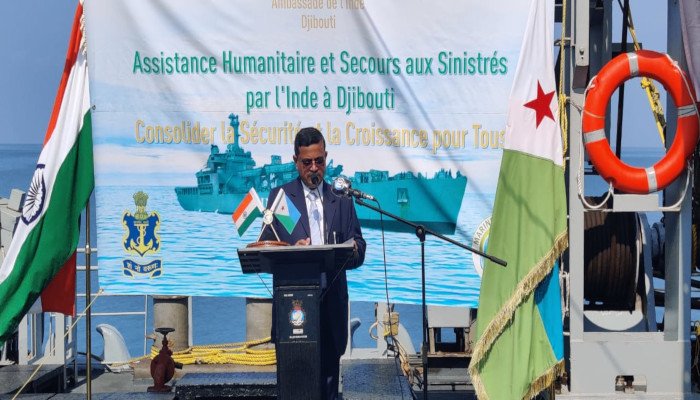
Mission SAGAR-II was executed, between 06 and 20 November 2020, by another of the Indian Navy’s Landing Ships [Tank], the INS Airavat. The ship arrived Mombasa, Kenya on 02 November 2020, and disembarked humanitarian aid meant for the people of South Sudan.[17] She entered Port Massawa, Eritrea, on 06 November 2020 once again disembarking food aid, before proceeding on a similar mission to Djibouti[18] on 10 November 2020. In Djibouti, the food-supplies were accepted on behalf of the Government of Djibouti, by Mr Ifrah Ali Ahmed, Secretary General, Ministry of Social Affairs, and Solidarity of Djibouti, in the presence of Mr Ashok Kumar, Ambassador of India to Djibouti.
As had been the case with the deployment undertaken earlier by INS Kesari, Mission SAGAR-II once again reinforced India’s position as a dependable partner in the IOR, with the Indian Navy as the first responder. The mission also highlighted the importance accorded by India to her relations with her maritime neighbours and strengthened the bonds of the latter with India.
Mission SAGAR-III
“Executed by INS Kiltan, Mission SAGAR III was focused upon Vietnam and Cambodia.” The Kiltan arrived at the port of Nha Rong in Ho Chi Minh City, on 24 December 2020[19] and delivered fifteen tonnes of HADR stores for the flood-affected people of central Vietnam. The aid was handed over to Vietnam’s Central Steering Committee for National Disaster Prevention and Control. The Kiltan then sailed for Sihanoukville, Cambodia, arriving on 29 December 2020. She handed over another fifteen tonnes of HADR stores for flood-affected people[20] to the National Disaster Management Committee (NDMC). As had been the case with the two earlier SAGAR missions, this deployment once again established India as a dependable partner for southeast Asian nations and the first responder in the region.
Mission SAGAR-IV
On 14 March 2021, INS Jalashwa sailed to Port Anjouan, Comoros to deliver 1,000 tonnes of rice to the island country. This was the second time that an Indian naval ship had called at ports in the Comoros, as part of Mission SAGAR. Thereafter, on 22 March 2021, the Jalashwa called at Port Ehoala in Madagascar and delivered a consignment of 1,000 tonnes of rice and 100,000 Hydroxychloroquine tablets in response to an appeal by Madagascar for assistance to deal with natural calamities. The aid package was formally handed over by Captain Pankaj Chauhan, Commanding Officer of the Jalashwa, in the presence of His Excellency, Mr Abhay Kumar, Ambassador of India to Madagascar and was received on behalf of the Republic of Madagascar by the Hon’ble Prime Minister, Mr Christian Ntsay. Also present at the ceremony to mark the handing over of the aid package, were Mr Jerry Hatrefindrazana, Governor of the Anosy Region; and Mr Georges Mamy Randrianaina, Mayor of Fort Dauphin.[21]
On the eastern seaboard, also as part of Mission SAGAR-IV, the Airavat called at the Indonesian port of Tanjung Priok, on 24 August 2021, where she delivered one hundred Liquid Medical Oxygen (LMO) containers and three hundred Oxygen Concentrators to Indonesia in response to a request from the Government of Indonesia.[22]
The Indian Navy’s contribution to the fight against COVID-19 did not end with these deployments. Throughout the pandemic, the IN provided assistance to a number of governmental and public service agencies. For example, IL-38 and Dornier aircraft of the Indian Navy were used to transport doctors, protective equipment, and medicines throughout the country,[23] and naval hospitals were tasked to receive and treat the public at large. Naval innovation was in striking evidence as witness the fact that Surgeon Lieutenant Commander Arnab Ghosh from the Institute of Naval Medicine in Mumbai developed the NavRakshak — a new version of personal protective equipment (PPE) that provided not only optimal protectiveness but also optimal breathability, for military and civilian medical and paramedical personnel. This protective gear, colloquially called the ‘Ghosh Suit’, is made of a special, multi-layered, breathable material, and provides both, protection, and comfort for up to 12 hours to medical personnel treating patients in humid and hot climates. This equipment was used during Operation SAMUDRA SETU, and some components included in the kit were also supplied to countries from which the evacuation was carried out (Iran, Sri Lanka, Maldives).
Conclusion
In conclusion, it is today widely acknowledged that the actions of the Indian Navy during the pandemic were timely and executed with a clear intent to assist not just Indian citizens but also our maritime neighbours, while maintaining full operational readiness. Indian Naval ships, whether ‘mission-deployed,’ or sailing for operational tasks closer home, or getting ready to transport men, material, rations, or medical equipment to and across coastal states and neighbouring countries, maintained full operational readiness at a time of pan-global health crisis.[24] The Indian Navy effectively maintained and expanded goodwill during an emergency and demonstrated its ability and preparedness to serve as a security provider in the event of non-traditional threats. This is in contrast to a lack of any similar demonstrable commitment by navies such as that of the People’s Republic of China that profess to be regional powers. The Indian Navy is a clear epitome of maritime and national excellence, and this saga continues…
About the Authors:
Group Captain Raj Mongia (Corresponding Author) is a PhD scholar (part-time) at the Amity Institute of Defence and Strategic Studies, Amity University, Uttar Pradesh, India. He may be reached at rajmongia@iitbombay.org
Brigadier Anand Kumar Tewari is Director and HOI, Amity Institute of Defence and Strategic Studies, Amity University, Uttar Pradesh, India. He may be contacted at aktewari@amity.edu
Dr Roshan Khanijo is Asst Director Research, United Service Institution of India, Rao Tula Ram Marg, New Delhi, India. She may be contacted at roshan7411@gmail.com
Endnotes:
[1] Captain Kamlesh Kumar Agnihotri, “C Two Double I: Indian Navy’s Strategy to Face the Covid-19 Challenge”, CENJOWS website, https://cenjows.in/wp-content/uploads/2022/06/Indian-Navy-by-Capt-IN-KK-Agnihotri-on-14-Apr-2020.pdf
[2] JBS Umanadh, “INS Sahyadri Visits Fiji”, Deccan Herald, 13 August 2018.
[3] Bihan Tang et al, “Medical Services Provided on the ‘Harmonious Mission—2017’ Peace Ark from China”, BMJ Mil Health 2021;0:1–7. doi:10.1136/bmjmilitary-2020-001659.
[4] The Hindu, “Indian Naval Crew has Rescued more than 192 People in Cyclone-hit Mozambique”, 24 March 2019.
[5] “Cyclone Berguitta – Mauritius”, https://www.indiannavy.nic.in/content/cyclone-berguitta-mauritius#.
[6] Bhargav Acharya, “The Indian Navy and India’s Overseas Citizens: Operations Sukoon and Rahat”, National Maritime Foundation, 22 May 2017 https://maritimeindia.org/View%20Profile/636310261881735675.pdf.
[7] Abhishek Bhalla, “26 Indian Navy Personnel Test Positive for Covid-19, Several Feared Infected on INS Angre Base”, India Today, April 2020.
[8]Financial Express, “Indian Navy Soft Power – Sailing through Pandemic”, 03 December 2022.
[9] Commander Anand Kumar and Mr Suriya Narayanan, “Mitigating Covid 19: The Indian Navy in the Vanguard-As Always”, National Maritime Foundation, 16 May 2020, https://maritimeindia.org/mitigating-covid-operation-samudra-setu/
[10] Arfa Javaid, “What is Operation Samudra Setu?”, Jagran Josh, 08 May 2020, https://www.jagranjosh.com/general-knowledge/operation-samudra-setu-1588919131-1
[11] Ananth Narayan K, “Indian Navy Completes Operation Samudra Setu”, Times of India, 8 July 2020.
[12] Press Information Bureau, “Indian Navy Completes Operation Samudra Setu”, Ministry of Defence Press Release, 08 July 2020.
[13] Captain Sarabjeet S Parmar, “Mission Sagar: Maintaining a Positive and Favourable Maritime Environment in the Face of the Covid Pandemic”, National Maritime Foundation, 15 June 2020, https://maritimeindia.org/wp-content/uploads/2020/06/Mission-SAGAR-Capt-SS-Parmar-14-June-2020.pdf.
[14] Ibid.
[15] Financial Express, “INS Kesari Enters Port of Madagascar, Medicines Handed over to Authorities under Mission Sagar”, 03 December 2022.
[16] Press Release, “Handing Over Ceremony of Second Consignment of Medical Supplies from India”, Foreign Affairs Department, Ministry of Foreign Affairs and Tourism, Republic of Seychelles, 07 June 2020.
[17] Manjeet Negi, “SAGAR II: INS Airavat Reaches Kenya with Food Aid for South Sudan”, India Today, 20 November 2020.
[18] PIB Delhi, “Mission SAGAR – II Handing Over Food AID to Djibouti by INS Airavat”, 12 November 2020.
[19] PIB Delhi, “Mission SAGAR III – INS Kiltan Arrives At Ho Chi Minh City”, 24 December 2020, https://pib.gov.in/PressReleasePage.aspx?PRID=1683396
[20] PIB Delhi, “Mission SAGAR III – INS Kiltan Arrives at Sihanoukville, Cambodia”, 29 December 2020, https://pib.gov.in/PressReleaseIframePage.aspx?PRID=1684365
[21] Sea and Coast, Voice of Maritime Community, “Mission SAGAR IV INS Jalashwa Arrives at Port Ehoala (Madagascar)”, 23 March 2021, https://www.seaandcoast.in/News/23153/mission-sagar-iv-ins-jalashwa-arrives-at-port-ehoala-madagascar
[22] Ministry of Defence, Press Information Bureau, “Mission Sagar – Indian Naval Ship Airavat Arrives at Jakarta, Indonesia to Deliver Medical Supplies”, https://pib.gov.in/PressReleaseIframePage.aspx?PRID=1748478
[23] Press Information Bureau, “Indian Navy Completes Operation Samudra Setu”, Ministry of Defence Press release, 08 July 2020.
[24] Capt Kamlesh Kumar Agnihotri, “C Two Double I: Indian Navy’s Strategy to Face the Covid-19 Challenge”, CENJOWS website, https://cenjows.in/wp-content/uploads/2022/06/Indian-Navy-by-Capt-IN-KK-Agnihotri-on-14-Apr-2020.pdf


Leave a Reply
Want to join the discussion?Feel free to contribute!