
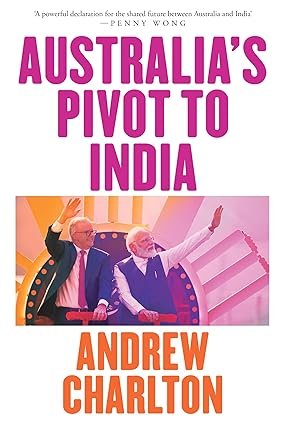
Andrew Charlton. Australia: Black Inc, 2023. 256 pages, Rs. 800 (online), ISBN 978-1760644772
Australia and India have long shared a unique bond, encompassing everything from cricket to a thriving Indian diaspora. The recently released book Australia’s Pivot to India by economist-turned-politician Andrew Charlton seeks to unravel the intricate tapestry of India-Australia relations. Moreover, the Australian Prime Minister, Anthony Albanese, gracing the book’s launch event underscores the significance of the book. The author’s writing is easy to comprehend, thereby making this book an engaging journey.
The book weaves a narrative of the historical connections between the two nations, highlighting their mutual support during food shortages and the pivotal role played by the Indian Garole sheep in the success of Australia’s wool industry. Diplomatic recognition in 1817, and maritime trade from Bombay, Madras, and Calcutta to New South Wales enriched their ties during colonial times. Notably, Australia acknowledged India’s sovereignty in 1944, even before its formal independence. Yet, the book observes that these relations did not progress as rapidly as they could have, following India’s independence. Charlton’s objective lies in shedding light on the historical depth of this relationship; further, he emphasises that it has not been leveraged to its full potential over the past seventy-five years.
According to Charlton, the foundation or the ‘central core’ of the bilateral relationship between Australia and India is their economic relation. Identifying this, he delves into how divergent economic policies drove a wedge between the two nations and credits India’s economic liberalisation as a catalyst for rejuvenating the relationship since it increased economic interactions between the two nations, thereby, creating more opportunities for diplomatic interaction between the two.
India-Australia relations, often summed up as the “Three C’s” — the Commonwealth, curry, and cricket — have been positive for many years. This book provides a comprehensive overview of the relationship, including chapters on cuisine, cricket, the Commonwealth, commerce, and the author’s personal experiences while travelling through India. It also highlights the new focus on the “Four D’s” — democracy, defence, dosti (friendship), and diaspora.
The author’s overarching goal is to emphasise (to Australians) the significance of fostering a strong relationship with India, an emerging global superpower. He underscores that the Indian diaspora in Australia is the bridge to India, crucial for building a strong relationship with this emerging global powerhouse. Hence, Australians should actively work on creating a welcoming environment for the Indian diaspora to strengthen their ties with India.
While talking of India-Australia relations one cannot overlook the Indian Ocean, which is of great significance to both the countries for trade and security. Both countries share a common goal of maintaining a free, open, and inclusive Indian Ocean. Charlton also addresses Australia’s evolving stance toward India’s military modernisation and assertiveness, especially with respect to India’s deepening engagement with the United States. As a result, Australia and India have been engaging on a variety of fronts, including the Quadrilateral Security Dialogue (Quad), trilateral, bilateral, and other multilateral forums. They have also participated in various military exercises, including MALABAR and INDAUDEX.
Charlton’s book effectively conveys the historical nuances of India-Australia relations and the reasons behind their previous shortcomings and gradual improvements. The book’s title — Australia’s Pivot to India — naturally evokes thoughts of the shared Indian Ocean between the two countries. However, the book does not extensively explore maritime collaboration, aside from the mandatory historical mentions, shared Indo-Pacific goals, and ongoing joint maritime exercises.
While the author briefly references collaboration in oceanographic studies and Antarctic exploration between India and Australia, he does not delve into the specifics regarding the potential for future cooperation. Charlton acknowledges Australia’s need for partners in order to pool resources for building its defence capabilities, however, leaves the question of how India could fit into this equation unanswered.
The book touches on Australia’s ambitions in the Pacific Island nations but omits any discussion of collaborative efforts, such as the International Solar Alliance and the Coalition for Disaster Resilient Infrastructure, to which both countries have contributed. The author also refrains from suggesting potential joint ventures in enhancing regional infrastructure, connectivity, and security in the Pacific Island region. The book does not mention Australia’s lead role in the marine ecology spoke of the IPOI[1], nor does it discuss any possible collaborations between the two countries on any of the IPOI spokes.
Charlton’s book does not explore non-traditional threats with respect to maritime crime emerging from the sea, including those of illegal migration and drug trafficking. This is a significant omission, as these threats are becoming increasingly important in the Indian Ocean Region.
In comparison, D Gopal’s book India-Australia Relations: Convergence and Divergence, which was published over a decade ago, discusses energy security, security of the Indian Ocean, and non-traditional security challenges in the Indian Ocean. This suggests that there is room for more discussion on the collaboration between Australia and India in the Indian Ocean, given that new challenges are emerging.
Considering the weight that the title lends to a book, Charlton could have added more value by providing a more detailed discussion of the maritime relationship between Australia and India. He could have explored the specific ways in which the two countries can collaborate to address non-traditional threats of maritime crime, including illegal migration, drug trafficking, piracy, and cyber security. He could have also discussed the potential for cooperation in other areas.
In conclusion, Australia’s Pivot to India is a valuable resource for those interested in the historical aspects of bilateral relations between India and Australia, as well as the Australian Government which seeks to raise awareness among Australians about the benefits of hosting the Indian diaspora. However, readers looking at the maritime dimension may find that while the book touches on this aspect, it could benefit from a more in-depth exploration of potential collaborations and opportunities in this realm.
*****
Endnotes
[1] The Indo-Pacific Ocean’s Initiative (IPOI) accords first-order specificity to SAGAR (Security And Growth for All in the Region) — India’s maritime policy. It was first introduced by India’s Prime Minister Narendra Modi at the Shangri-La Dialogue in 2018, and aims to promote a free, open, and inclusive Indo-Pacific.


Leave a Reply
Want to join the discussion?Feel free to contribute!