
2025 EDITION OF THE INDO-PACIFIC REGIONAL DIALOGUE (IPRD-2025)
INDO-PACIFIC REGIONAL DIALOGUE 2025: PROMOTING HOLISTIC MARITIME SECURITY AND GROWTH: REGIONAL CAPACITY-BUILDING AND CAPABILITY-ENHANCEMENT
CONCEPT NOTE
The Indo-Pacific Regional Dialogue (IPRD) is the Indian Navy’s annual, international, apex-level conference, and is the principal manifestation of the Navy’s outreach at the strategic level. Each successive edition of the IPRD seeks to sequentially focus upon the pillars of the “Indo-Pacific Oceans Initiative” (IPOI), which had been launched by India’s Prime Minister, Shri Narendra Modi, on 04 November 2019 at the 14th East Asia Summit in Bangkok.
The seven pillars of the IPOI serve to identify specific maritime lines-of-thrust and all seven are intricately and inextricably connected to one another. As such, the IPOI is best thought of as a complex, deeply interconnected ‘web’, with each of its seven ‘spokes’ representing a specific maritime ‘line-of-thrust’. Over the six years that have elapsed since its initial enunciation, the IPOI has gained considerable international traction, with several countries volunteering to take the lead along one or more of these maritime ‘lines-of-thrust’, as is depicted in the following conceptual-schematic:
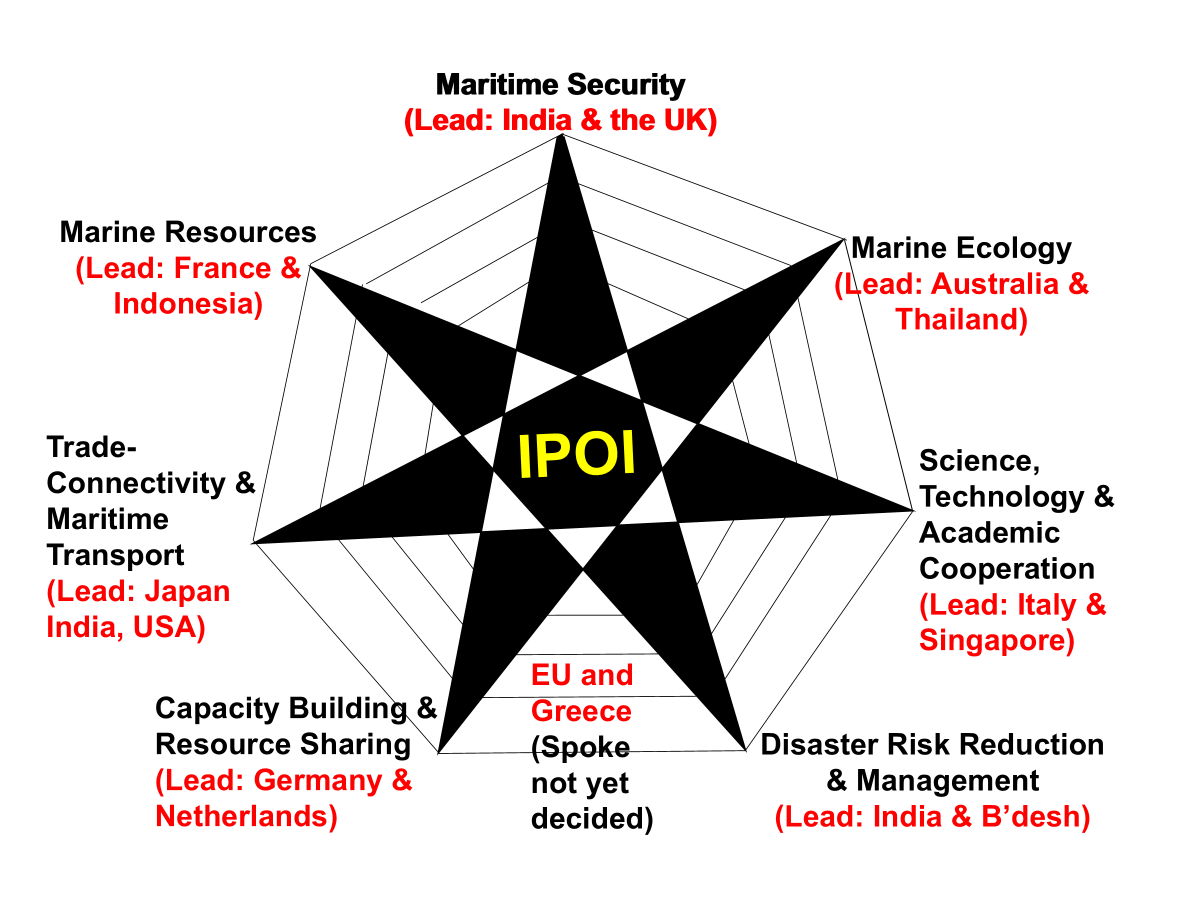
As such, the IPOI provides first-order-specificity to India’s maritime policy, which is encapsulated in the acronym MAHASAGAR (standing for “Mutual And Holistic Advancement for Security and Growth Across Regions”). Appropriately, “Mahasagar” (महासागर) is also the Hindi word for the ocean. Each successive edition of the IPRD seeks to provide second- and third-order-specificity to the IPOI.
The expression “across regions” to which the Indian maritime policy of MAHASAGAR refers is, for the present, the Indo-Pacific. India’s spatial conceptualisation of the Indo-Pacific stretches from the eastern coastline of Africa to the western shores of the Americas and from the southern coastline of Asia to that of Antarctica. While the Indo-Pacific is a predominantly maritime space, it does, of course, incorporate an important continental dimension as well. Importantly, for India, the Indo-Pacific is not, in and of itself, a “strategy”. It is, instead, a “strategic geography” within which New Delhi formulates and executes a number of diverse strategies, all designed to promote regional economic and societal security and growth, thereby meaningfully contributing to peace, prosperity, and stability. Indeed, holistic maritime security and mutually reinforcing economic and societal growth throughout the Indo-Pacific is India’s desired end-state for the region.
Any architecture for holistic-security within the Indo-Pacific — indeed, as in every other regional space in the world — must necessarily have at least three layers: a conceptual layer (this, in the case of the Indo-Pacific could be the expansion of the acronym MAHASAGAR), a political layer (this could well be an amalgam of IORA and the East Asia Summit [EAS]), and, finally, and most importantly, an executive layer that will actually “do the doing” and comprise seagoing maritime agencies — mostly but not solely embodied by navies and coast guards. This would almost certainly have to be an amalgam of the Indian Ocean Naval Symposium [IONS] and the Western Pacific Naval Symposium [WPNS]). With the Indian Navy resuming the chair of IONS for the second time since the launch of this structure in the year 2008, there is considerable hope that the impetus that has been provided by the previous illustrious chairs would be accelerated even further.
Building upon the success garnered through the previous three editions of the IPRD in fleshing out specific maritime lines-of-thrust of the IPOI, this year’s edition — IPRD-2025 — will focus upon the manner in which regional growth, maritime stability, and holistic maritime security could best be promoted through specific regional measures for capacity-building (connoting ‘material wherewithal’) and capability-enhancement (denoting human organisational and functional skills).
As has been the case in earlier editions, IPRD-2025 will encompass wide-ranging and multifaceted discussions by a galaxy of globally renowned experts in multiple facets of the Indo-Pacific maritime domain. The presentations and deliberations of this mega international conference will go well beyond a mere regurgitation of regional maritime problem-sets. They will concentrate, instead, upon the identification of specific solutions that could guide maritime policy formulation and execution at national, sub-regional, and pan-regional levels, so as to address prevalent and foreseeable challenges and aspirations within the Indo-Pacific.