
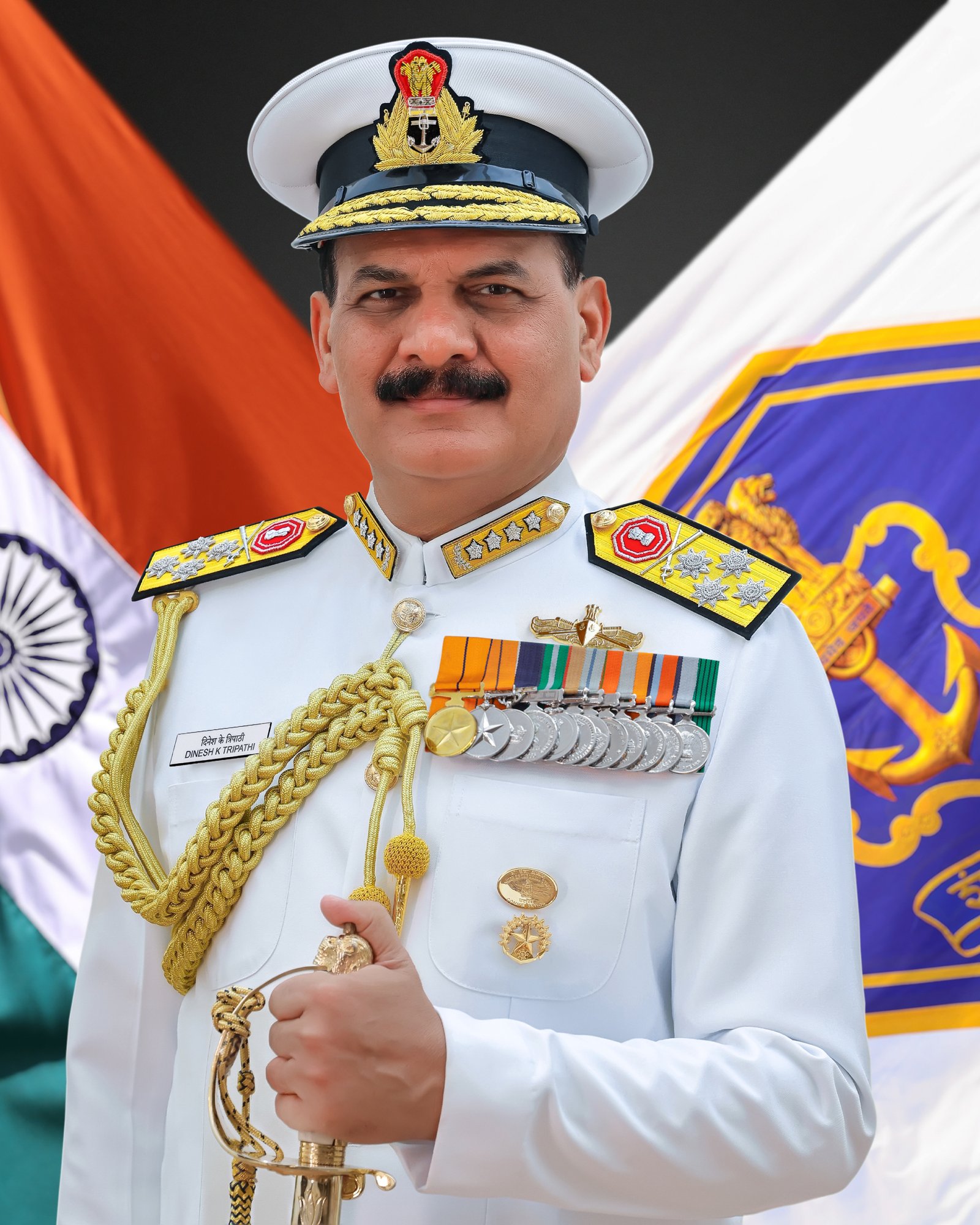
Admiral Dinesh Kumar Tripathi, PVSM, AVSM, NM, IN (Retd)
Admiral Dinesh K Tripathi assumed command as the Chief of the Naval Staff on 30th April 2024 at a time of increasing maritime competition and India’s expanding maritime interests across the Indo-Pacific and beyond. A career surface warfare officer and maritime strategist with over four decades of commissioned service, he has been associated with the operational, technological and doctrinal evolution of the Indian Navy, contributing to national maritime preparedness, force modernisation, human capital development, indigenous technology infusion for an Atmanirbhar Future-Ready Navy, and an integrated national security framework.
Formative Years and Early Career
An alumnus of Sainik School, Rewa; the National Defence Academy, Khadakvasla; and the Defence Services Staff College, Wellington, he has also attended the United States Naval War College, Newport, USA. Commissioned into the Indian Navy on 01st July 1985, he specialised in Communication and Electronic Warfare – a domain central to modern naval warfare and networking ashore. Admiral Tripathi holds a M. Phil degree from Mumbai University for his research on the subject ‘Military Leadership Challenges for the Millennial Generation.’ He is presently pursuing a PhD from Mumbai University on the topic ‘Effective Cooperative Maritime Security Framework for the Indian Ocean Region: Imperatives, and Challenges.’
Command at Sea and Operational Experience. Over a long seagoing career spanning more than two decades, Admiral Tripathi has commanded frontline warships from missile corvettes to a multi-mission frigate and has held key operational appointments at Headquarters Western Fleet, as Fleet Operations Officer, Fleet Communication Officer and Fleet Electronic Warfare Officer. During these tenures, Admiral Tripathi was involved in the planning and execution of a wide spectrum of high-tempo deployments, maritime security operations, contingency response and humanitarian assistance missions, including Operation Parakram (2001 – Parliament attack response) and Operation Madad (2004 – Tsunami relief).
Leadership in Flag Rank
On promotion to the Flag rank, he commanded the Indian Navy’s Eastern Fleet, where he spearheaded maritime operations during Op Bandar (2019 – Balakot Strikes) and maintained high operational readiness of the Eastern Fleet, enhancing Indian Navy’s rapid response capability. Subsequently, as the Flag Officer Commanding-in-Chief of the Western Naval Command, he ensured a robust maritime posture along India’s Western seaboard to demonstrate deterrence, while strengthening coastal and offshore security. During this tenure, he oversaw the timely evacuation of around 1500 Indians from war-torn Sudan as part of Operation Kaveri (2023). Later, as part of Operation Sankalp, he steered the Indian Navy’s initial response to the Red Sea crisis by enhancing naval deployments in the western Indian Ocean, contributing to safety, security and stability. These actions reinforced India’s role as a credible First Responder and Preferred Security Partner in the region.
Staff andPolicy Appointments. In addition to hisoperational commands, Admiral Tripathi has held a series of key staff and policy appointments at Naval Headquarters, where he shaped operational planning, maritime strategy and long-term capability development. As Director ofNaval Operations, Principal Director ofNetwork Centric Operations and Principal Director Naval Plans, he was closely associated with the evolution of op concepts, strengthening maritime domain awareness and embedding network-enabled operations across the fleet. He holds the unique distinction of serving in senior roles across all three branches of the Navy – capability development, operations, and personnel – equipping him with an unprecedented institutional breadth and 360-degree understanding of the Navy as an integrated whole.
Senior Flag Appointments. In subsequent senior appointments, he steered institutional advancement and capability development across multiple domains. As Assistant Chief of Naval Staff (Policy and Plans), he guided force restructuring and future capability planning, enhancing combat potential, optimising force utilisation and preparing the Navy for emerging operational challenges. As Director General Naval Operations, he directed the Navy’s operational response in the aftermath of the Galwan clashes – a moment of acute strategic tension – ensuring readiness, deterrence, and coordinated security posture across the maritime domain. As the Vice Chief of Naval Staff, he aligned operational priorities with resource allocation and capability development, accelerating modernisation across all domains of naval warfare, to catalyse cohesive institutional growth of the Service.
Professional Military Education & Human Resource Development. He also made enduring contributions to professional military education and human resource development. During his tenure as the Commandant, Indian Naval Academy, the Navy’s training ecosystem was reinvigorated with greater technology infusion and leadership development initiatives, culminating in the Academy being awarded the President’s Colours. As Chief of Personnel – the HR head of the Navy – he advanced progressive personnel policies, expanded opportunities for women across cadres to realise the full potential of Nari-Shakti, oversaw the significant transition involved in induction of Agniveers into the Navy, and streamlined personnel management systems to enhance efficiency, inclusivity and morale.
As Chief of the Naval Staff
Operation Sindoor: As the Chief of the Naval Staff, Admiral Tripathi led the Indian Navy during Operation Sindoor, overseeing the deployment of ships, submarines and aviation assets, including a Carrier Battle Group in the Northern Indian Ocean. The swift deployment, aggressive posturing and demonstrated strike capability served as a credible deterrent, sending a strong strategic signal during a period of heightened tensions.
Operation Urja Suraksha. Admiral Tripathi led the ongoing Operation Urja Suraksha, directing the deployment of naval assets to safeguard India’s maritime interests and critical energy sea lanes. The operation reflects enhanced operational preparedness, sustained maritime domain awareness and coordinated force projection across key areas of strategic importance. The Indian Navy’s proactive presence and rapid response capability continue to reinforce regional stability, ensure security of vital maritime infrastructure and convey a strong strategic deterrent posture in the evolving security environment.
Strategic Vision and Force Modernisation. Aligned with the national vision of Viksit Bharat @ 2047, as the CNS, Admiral Tripathi articulated Indian Navy Vision-2047, outlining strategic priorities and objectives for the Navy over the next two decades. He also ensured revision of Navy’s apex strategic publications – the Indian Maritime Doctrine and the Indian Navy Maritime Security Strategy – to address the evolving complexities of the Indo-Pacific maritime security landscape. He has advanced a future-ready, Atmanirbhar naval force through accelerated modernisation and the infusion of indigenous technology, instituting Special Task Forces for innovation and technology induction to drive self-reliance, horizontally across platforms and vertically to component and sub-component levels, while fostering co-design and co-production partnerships with industry.
Jointness and National Security Architecture. He has encouraged greater jointness among the Defence Forces and deeper coordination with the Indian Coast Guard, enabling integrated planning, seamless maritime security operations, and improved coastal and offshore surveillance. His advocacy of national-level wargaming, strengthening of India’s drone ecosystem, and setting up of high-level committees on national security and strategic matters have strengthened institutional decision-making and supported India’s long-term national security objectives.
Maritime Diplomacy and Regional Engagements. His tenure also advanced India’s foreign policies and diplomatic endeavours, through operationalisation of Vision MAHASAGAR and the conduct of a historic trinity of major maritime engagements at Visakhapatnam, including the International Fleet Review (IFR), multilateral maritime exercise MILAN, and IONS Conclave of Chiefs. The IFR and MILAN witnessed record participation from 74 countries, and the IONS Conclave marked India’s return to the Chairmanship after 16 years. These events cemented India’s stature as a responsible maritime power, and a trusted Global Security Partner.
Personnel Wellbeing and National Maritime Consciousness. He has consistently emphasised holistic wellness and wellbeing, integrating physical, mental, emotional and spiritual aspects, to sustain combat effectiveness and enhance resilience. He has placed equal focus on personnel preparedness, prioritising training, safety and infrastructure. At the same time, initiatives aimed at strengthening civil-military synergy, include outreach activities and operational demonstrations along India’s coastline, expanding maritime awareness among citizens, and reinforcing public understanding of the importance of the maritime domain.
Recognition and Personal Life
Admiral Tripathi is a recipient of the Param Vishisht Seva Medal, Ati Vishisht Seva Medal and Nau Sena Medal in recognition of distinguished service and devotion to duty. While he maintains a keen interest in tennis, badminton, and cricket, he is also a student of international relations, military history and leadership. He is married toMrs Shashi Tripathi, an artist and homemaker. They have a son, Divyam, who is married to Tanya.