THE ‘INDO-PACIFIC’ WITH INDIAN CHARACTERISTICS
Yash Malhotra*
10th July 2018
It is heartening to see idea of the ‘Indo-Pacific’ on a roll again. It is true that the term actually connotes a singularity of the Indian Ocean and the Pacific Ocean, but of note is the fact that the Indian Ocean is dominated by the peninsular configuration of India, which acts as the focal point of all Sea Lines of Communication (SLOC) and International Shipping Lanes (ISL), connecting not just the Indian and Pacific oceanic expanses, but those of the Atlantic and Pacific as well. The littoral nature of the region, and the key role played by the oceans in facilitating the free flow of trade and commerce, has lent a distinct maritime hue to its security architecture[1]and associated geo-political and geo-economic nuances. One cannot help recounting what K M Panikkar said way back in 1945: “While to other countries the Indian Ocean is only one of the important oceanic areas, to India it is the vital sea. ……. No industrial development, no commercial growth, no stable political structure is possible for her unless the Indian Ocean is free and her own shores fully protected. The Indian Ocean must therefore remain truly Indian;”[2]—where relationships of countries of the Indian Ocean Region (IOR) with India, would be more important than with those with outside powers.[3]
One has to underline the shift in world-view from a Euro-Atlantic to an Indo-Pacific focus[4], and the repositioning of global power towards Asia, with the 21st Century being termed by some as the ‘Asian Century’, impacting India’s maritime environment. This is particularly so, given the growing dependence of resurgent East and South-East Asian economies (including that of China), on the imperative of raw materials, notably energy (oil and gas), moving across the Indian Ocean. The bulk of Indian trade to Pacific Rim Countries, too, passes through South China Sea. Consequently, events in South and East China Seas assume importance for India, just as the environment in the IOR does for China and other East and South East Asian countries. Further, almost three quarters of the trade traversing the Indian Ocean, primarily in the form of oil and gas, belongs to States external to the region. Hence, all major States have a stake in a stable IOR, which otherwise has a very restive environment on account of extreme diversities in economies; being the de facto home of global terrorism as also the locus of 70 per cent of the world’s natural disasters; apart from India, Pakistan and a host of extra-regional powers, including China, which operate in the region and possess nuclear weapons[5]; and so on.
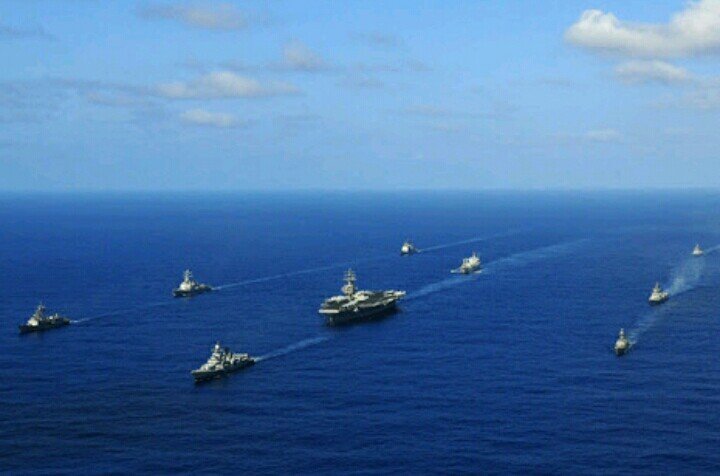
As a result, all major powers have deployed substantial military forces in the IOR. For example, in addition to maintaining the remnants of expeditionary forces in Iraq and Afghanistan, the US Fifth Fleet is headquartered in Bahrain, and uses the island of Diego Garcia as a major air-naval base and logistics hub for its Indian Ocean operations. In addition, the USA has also deployed several major naval task forces there, including Combined Task Force 150 (tasked with disrupting terrorist organisations and their related illegal activities by restricting their freedom of manoeuvre in the maritime domain); Combined Task Force 151, whose mission is to deter and disrupt piracy and armed robbery at sea and to engage with regional and other partners to build capacity and improve relevant capabilities in order to protect global maritime commerce and secure freedom of navigation; and, Combined Task Force 152 (tasked with enhancing regional naval cooperation in the Persian Gulf, especially between GCC nations, which are charged with the responsibility of safeguarding the flow of oil through the Persian Gulf)[6]. France, meanwhile, with its naval assets in Djibouti, Comoros, Reunion, and Abu Dhabi, is perhaps the last of the major European powers to maintain any significant presence in the north and southwest quadrants of the Indian Ocean. Also of note are China’s efforts to get a foothold in the IOR, first with the ‘String of Pearls’, and now with the ‘One Belt One Road’ (OBOR) initiative (which is, in its current avatar, known as the ‘Belt and Road Initiative [BRI]).
The idea of ‘Indo-Pacific’, in one click brings the Pacific Ocean into play for those geopolitical entities located west of Malacca, and the Indian Ocean into play for those that lie east of Malacca. It must be underlined that throughout history, geography (as manifested in the straits that define eastern approaches to the Indian Ocean), has dictated a sharp dividing line between East Asia and South Asia. The various regions so emerging, have geopolitically and historically, pursued distinct civilizational courses[7]. The ‘Indo-Pacific’ could well provide the glue to link geographically dispersed nations and bind them in compacts of several types. For India, this also represents opportunities to break out of the sub-continental ‘box’ into which China and Pakistan have managed to confine it[8], as also to develop cordial relations with all Pacific and Indian Ocean littorals, over and above the USA and France, as the geographical construct of the region compels the evolution of a collaborative approach to maritime security[9]. The following definition captures the spirit of the idea of the ‘Indo-Pacific’ perfectly: “Indo-Pacific is an integrated theatre that combines the Indian Ocean and the Pacific Ocean, and the land masses that surround them. It is both a strategic as well as an economic domain comprising important sea-lines of communication that connect the littorals of the two oceans.”[10] It therefore needs be underlined that each country must bring its national interests to the fore when examining the idea, which now should cover both the Indian and Pacific Oceans as required.
Since China is foraying into the Indian Ocean and has issues with the US in the Western Pacific, particularly the South China Sea, let us focus on China first.
In the Pacific, China feels that on issues concerning its territorial sovereignty and maritime rights and interests, some of its offshore neighbours are taking provocative actions and reinforcing their military presence on China’s reefs and islands that they have illegally occupied. It is thus a longstanding task for China to safeguard its maritime rights and interests”.[11] China approaches the Indian Ocean as primarily a landlocked power, seeking port access to littoral countries such as Pakistan, Sri Lanka, Bangladesh, Myanmar, Djibouti and others, thus bringing it into potential conflict with India. On the other hand China has a long coastline fronting the Western Pacific, bringing it into potential conflict with the US.[12] Therefore China has to follow a ‘two ocean strategy’ — one each for the Pacific and Indian Oceans. China’s actions in the South China Sea of resorting to ‘Salami Slicing’ or ‘Grey Zone Warfare’ to claim ownership of practically the complete South China Sea; and the ‘String of Pearls’ and OBOR/BRI constructs in the Indian Ocean, are of concern to the world community, notably the littorals of the Western Pacific and the Indian Oceans. As is evident, in today’s geopolitical matrix, the Indian Ocean is where the rivalry between India and China interlocks with the rivalry between the US and China in the Pacific[13].
As for the USA, it feels that its interest lies in a ‘free and open Indo-Pacific’. It sees a geopolitical competition between free and repressive visions of world order taking place in the region[14]. China is leveraging military modernisation, operational influence, and predatory economics, to coerce neighbouring countries to reorder the Indo-Pacific region to its advantage. As China continues its economic and military ascendance, the US apprehends that it will continue to pursue a military modernisation programme that seeks Indo-Pacific regional hegemony in the near-term and the displacement of the USA, so as to achieve global pre-eminence, in the future”[15].
Apparently to contain China, the US seeks to increase quadrilateral cooperation (Quad) with Japan, Australia, and India,[16] while welcoming India’s emergence as a leading global power, and a stronger strategic and defence partner.
It will be noticed that the ‘Quad’ has, in one go, pitted the USA, Japan, Australia and India against China, and perhaps, against Russia (which appears to have been ignored) as well. The very concept of ‘Indo-Pacific’ has got hijacked east of Malacca, negating its very definition.
Can Russia be ignored?
Russia is no longer the feeble ‘Post-Soviet Union Dissolution’ country that it was until recently. It has rebuilt much of its military power and is confident enough to use it for geopolitical leverage.[17] The balance of power in the Indo-Pacific region is, therefore, far from binary,[18] with the actors being limited to the USA and China. Russia is right there, too!
For Russia, an important and significant component of its maritime policy in the Pacific Region is the development of friendly relations with China.[19] Similarly, the most important area of its policy in the Indian Ocean regional direction is the development of friendly relations with India.[20] The Russia-China cooperation in the Pacific is, indeed, noteworthy, as is the ‘Special and Privileged Strategic Partnership’ between India and Russia.
The success of the ‘Quad’, and, in turn, any Indo-Pacific Strategy, therefore, depends significantly on India’s willingness to be a part of it, which some call ‘a quasi-military alliance’[21]. If India does so, risks of strategic interests gradually misaligning,[22] a reduction in arms trade, and a body blow to its ‘Special and Privileged Strategic Partnership’ with Russia, cannot be ruled out. As for China, India would certainly not like to complicate its relations any further or be a part of any entanglement in the China-US rivalry.[23] Japan would have its own reservations, since it is making efforts to engage with both its large neighbours, namely, Russia and China. According to some reports, Australia is the weakest link in the very idea of a ‘Quad’, with an apparent lack of the required depth of understanding and rapport with the other three partners. Hence the ‘Quad’, currently at least, appears to be a little shaky!
When each country, as mentioned earlier, brings its national interests to the fore while examining the idea of ‘Indo-Pacific’, it will choose to come on board only if it sees itself providing the proverbial ‘glue’ to link itself to the other three and bind them in economic, developmental and political compacts, rather than military or quasi-military alliances, that might end-up ‘offending’ China and/or the others.
Viewed from another angle, the ‘Quad’, for the present, represents only an ‘eastern leg’ of a geopolitical construct that is relevant to India. What about China in the Indian Ocean? The ‘Quad’ can surely not be solely a manifestation of ‘America First’. It must be underlined that while the South China Sea and Western Pacific are important, the Indian Ocean remains fundamental for India. Perhaps there is a case to have a ‘western leg’ of the ‘Quad’, with partnerships involving India, France, and South Africa, apart from the USA. India has to realise that while its current maritime security architecture may be adequate for small, local and regional confrontations, ‘big ticket’ engagements, notably with China, are still some years away. The ‘western leg’ of the ‘Quad’ gets underlined as does the India-US Strategic Partnership, the India-Japan cordiality, and, to an extent, the ‘Special and Privileged Strategic Partnership’ with Russia
Right now, while perhaps everybody, including China, realises that a free, open, peaceful, and stable Indo-Pacific is need of the hour, China appears to be aggressively busy ‘salami-slicing’ the islands and reefs in the South China Sea; expanding and strengthening its ‘String of Pearls’; and, using economic predatory tactics to almost force its OBOR/BRI endeavour as an economic and developmental front in the IOR; thus compelling others to counteract.
The Cold War offers clear evidence that USA has considerable experience in interacting, on a sustained basis, with a country that is of comparable size, reach, and economic performance, but which embraces a distinctly different model of domestic political order.[24] Potential tensions between an established and a rising power — China in this case — are not new. Inevitably, the rising power impinges on some spheres that were, thus far, treated as the exclusive preserve of the established power[25] — a classic case of a ‘Thucydides Trap’[26]. Therefore, one must question whether the ‘Quad’ is really the answer that we seek in the Western Pacific.
On the other hand, in the Indian Ocean, with credible partnerships in place with not only the USA, but also with Japan and Russia, India’s maritime forces can assume a frontline role, and operate without inhibitions in the IOR and beyond. As a consequence, India has been enhancing its strategic influence through the use of soft power and by becoming a major foreign investor in mining, oil, gas, and infrastructure projects. In addition, India has also aggressively expanded its naval presence to include the establishment of listening posts in the Seychelles, Madagascar, and Mauritius; whether these be to combat piracy and terrorism, or to provide disaster-relief.[27] At the same time, it will counter/contain China and, more importantly, a China-Pakistan nexus. It needs to be noted that the Indian Navy now has a deployment-pattern known as ‘Mission Based Deployment’ (MBD), involving Indian warships remaining on station, on a continual basis, at six vital points in the IOR: off Assumption Island (Seychelles), off Agalega (Mauritius), off the East Coast of Africa, off southern Sri Lanka, in the northern Bay of Bengal, and, in the Persian Gulf. Relatively recently, Oman has permitted India the use of its Duqm port. France, as mentioned above, maintains an Indian Ocean Fleet based in Reunion, near Mauritius, and has permanent bases in Abu Dhabi, the Comoros, and, Djibouti. The recent (March 2018) Agreement with France ensures military use by India of these; the earlier Logistics Exchange Memorandum of Agreement (LEMOA) with the US, and now, with Indonesia for the deep-water port of Sabang; are crucial for India, both individually and collectively. The agreement with Indonesia ensures the Indian Navy’s reach across the eastern IOR, while the agreement with France ensures the same for the western IOR. India’s success in holding out at Doklam against Chinese threats carries a clear message, not only to India’s own neighbours, but to China’s as well. What is being signalled is India’s credibility as a trustworthy partner to its immediate friendly neighbours (Bhutan in this case) and, an encouragement to China’s smaller neighbours, such as Vietnam, Mongolia, Singapore and Japan, (which have themselves been pushing back against China), that Chinese bullying can, indeed, be countered by determined diplomacy and partnerships backed by military resolve.[28] Some observers warn India and others to be wary of the Chinese philosophy of ‘Nibbling and Negotiating’ concurrently — ‘yi bian tan yi bian ta’.[29] One thing is clear; the historically inherited idea of ‘Tianxia’ — a ‘China-centric world’ — is not inevitable. It can be successfully contested[30].
With regard to the predatory economic tactics of China, there is no need to be in awe of the OBOR/BRI. It may well be internal compulsions and economic weaknesses that are driving Chinese policy and that compel Beijing to mask the debt-traps inherent in the OBOR/BRI by projecting its sense of ‘manifest destiny’ and other grandiose forms of rhetoric that have been generated around the OBOR/BRI. Further, India and Japan’s joint proposal, in May 2017, for a multi-billion dollar ‘Asia-Africa Growth Corridor’ (AAGC), which China now wants India to go slow on;[31] India’s signing of the Transport Internationaux Routiers (TIR) Convention resulting in the early utilisation of the ‘International North South Transport Corridor’ (INSTC); and the UN raising a red flag over the economic, social and environmental risks of the OBOR in a number of countries, including South and Central Asia, where massive Chinese investments, compared to the relatively small size of their own economies, could ultimately push them into a ‘Debt Trap’;[32] are all significant issues that must be factored. The AAGC provides an alternative model of development for Asia and Africa, which respects sovereignty and democratic principles while encouraging local ownership of projects, skill development, and, transfer-of-technology[33].
For India, it is essential to understand that there are two ‘lines of divisions’ which the US has to contend with. One line of division lies between Russia and NATO/EU over the latter’s eastward enlargement and the European missile-defence programme, worsened by the events in Ukraine. Another line of tensions runs between China and the USA (along with its Asian allies) as they seek military and political domination in the western part of the Indo-Pacific region, control over natural resources and their transportation routes, and, influence in financial and economic decision-making[34]; in the process, quite possibly pushing China and Russia even closer to each other. India must analyse the answer to the question: ‘Does the US have adequate resources and political will under the present Trump dispensation for effective and sufficient deployment[35], both in Europe, and in the Indo-Pacific, for the ‘rebalance’ that it intends’? Resources apart, seeing the transactional nature of the Trump administration, particularly after withdrawing from the Iran Nuclear Deal (JCPOA), the 2015 Paris Agreement on Climate Change, and, the Trans Pacific Partnership (TPP) Agreement (which had excluded China), the US has relegated itself to the ‘Trust but Verify’ category bringing its own credibility into question. Close Russia-India ties therefore assume added importance, as do India’s partnerships with Japan, Australia, Vietnam, Singapore, France, South Africa, Oman, and some others. As Chancellor Merkel said, with regard to the European Union: “The US and Britain may no longer be completely reliable partners. Transatlantic ties are of paramount importance to us…but the current situation gives more reasons for us to take our destiny in our own hands.”[36] Similarly, the partnerships by India with countries other than the USA should only be seen as an attempt by India to take her destiny into her own hands!
Should there be a decline in Sino-US ties[37], as appears evident with the Trump administration, India need not unnecessarily be at odds with China, but could look to improve relations with both China and the US, and place herself firmly in the middle, making herself important to both nations. After all, India, through the ages, has developed a civilization whose attributes are exactly what that new order requires today— the innate syncretism (natural quality of amalgamating different cultures/religions) of its accommodative and self-confident culture; its easy embrace of vast diversity and plurality with an underlying spiritual and cultural unity; and, a deep conviction that to achieve greatness, a nation must stand for something more than itself — Vasudev Kutumbakam.[38]
China, too, must chip in. A self-restrained, fair and disciplined posture from China, at this juncture, would certainly promise a better outcome for great-power relations in the region[39]. The idea of the ‘Indo-Pacific’ should remain developmental and make good economic sense, in order to have most countries come on board, while ‘keeping a watch over one another’. In the instant case, it may not be such a bad idea to consider what Admiral Michael Mullen, Chairman of the Joint Chiefs of Staff, said in 2006 (when he was Chief of Naval Operations) [40]— “Indeed, where the old ‘Maritime Strategy’ focused on sea control; the new one must recognize that the economic tide of all nations rises not when the seas are controlled by one [nation], but rather when they are made safe and free for all.” Admiral Mullen went on: “I’m after that proverbial 1,000-ship Navy — a fleet-in-being, if you will —comprised of all freedom-loving nations, standing watch over the seas, standing watch over each other.”
*****************************
About the Author
Yash Malhotra is a retired Lieutenant General of the Indian Army Corps of Engineers. At the time of superannuation in 2004, he was Commandant of the College of Military Engineering, Pune. Presently he is a Research Scholar at the Savitribai Phule Pune University, Pune working on ‘Maritime Power Imperatives for India.’ He is also an Associate Member of the NMF. He can be reached at yashmal@hotmail.com and yashmalhotra@gmail.com
End Notes
[1] Gopal Prakash. Maritime Security in the Indo-Pacific: The Role of the US and Its Allies. (Maritime Affairs, Vol 13 No 1 Summer 2017), p, 27.
[2] Panikkar KM. India and the Indian Ocean: An Essay on the Influence of Sea Power on Indian History. (London, George Allen and Unwin Ltd, 1945), p, 84.
[3] Brewster David. India’s Ocean: the Story of India’s Bid for Regional Leadership. (London, Routledge, 2014),
pp, 4.
[4] Indian Navy. Ensuring Secure Seas: Indian Maritime Security Strategy. (New Delhi, Integrated Headquarters, Ministry of Defence (Navy), 2015), p, ii.
[5] Indian Navy. Freedom to Use the Seas: India’s Maritime Military Strategy. (New Delhi, Integrated
Headquarters, MoD (Navy), 2007), p, 37.
[6] Desilva-Ranasinge Sergei. Why the Indian Ocean Matters. (www.thediplomat.com/2011/03), accessed, 02 Jan 2017.
[7] Kissinger Henry. World Order. Op cit, p, 129.
[8] Prakash Arun Admiral. The Indo Pacific as a Regional Entity. (Email to the Author from Goa, dated 05 Jan 2016).
[9] Gopal Prakash. Maritime Security in the Indo-Pacific: The Role of the US and Its Allies. Op cit, p, 28.
[10] Singh Abhijit. What Does the Term Indo-Pacific Signify as Distinct from Asia-Pacific? (www.idsa.in), accessed, 11 May 2018.
[11] People’s Republic of China. China’s Military Strategy. (Beijing, The State Council Information Office, 26 May 2015), p, 2.
[12] Kaplan Robert D. Monsoon: The Indian Ocean and the Future of American Power. (New York, Random House, 2011), Part I, Chapter 1, p, 3.
[13] Kaplan Robert D. Op cit, p, 194.
[14] U S Government. National Security Strategy of the United States of America. (Washington, U S DoD, December 2017), p, 43.
[15] Mattis Jim. Summary of the 2018 National Defence Strategy of the United States of America: Sharpening the American Military’s Competitive Edge. (Washington, UD DoD, February 2018), p 2
[16] U S Government. National Security Strategy of the United States of America. Ibid, p, 44.
[17]Muraviev Alexey. Factoring Russian Military Power in the Indo-Asiaa -Pacific Strtegic Calculus. (www.aspistrategist.org.au), accessed, 15 May 2018
[18]. Ibid.
[19] Russian Federation. Maritime Doctrine of the Russian Federation. (Moscow, The Kremlin, 26 July 2015),
Paras, 62- 63.
[20] Ibid.
[21] Kuo A Mercy. What the EU Thinks of the US ‘Indo-Pacific’ Policy: Insight from Bernt Berger dated 31 Jan 2018. (www.thediplomat.com), accessed, 05 June 2018.
[22] Tsvetov Anton. What Does Trumps Indo-Pacific Strategy Mean for Russia.(www.thediplomat.com), accessed, 15 May 2018.
[23] Editorial Board. Sorting Out Strategic Confusion in the Indo-Pacific. www.eastasiaforum.org), accessed 16 May 2018.
[24] Kissinger Henry. World Order. Op cit, p, 138.
[25] Ibid, p, 139.
[26] Editorial. Reset Relations. (Times of India, Pune Edition, 07 September 2017), p 18.
[27] Desilva-Ranasinge Sergei. Why the Indian Ocean Matters. (www.thediplomat.com/2011/03), accessed, 02 Jan 2017.
[28] Deshpande Rajeev. A Message to China’s Other Small Neighbours. (Times of India, Pune Edition, 29 August 2017), p, 11.
[29] Dwivedi GG. The People’s Liberation Army at Ninety–Poised for a ‘Great Leap’: IDSA Comment 07 August 2017: (www.idsa.in), accessed, 07 September 2017.
[30] Bagchi Indrani. Don’t Waste A Good Crisis. (Times of India, Pune Edition, 08 September 2017), p, 14.
[31] Dasgupta Saibal. China Wants India to Go Slow on Asia-Africa Corridor. (Times of India, Pune Edition, 03 September 2017), p,13.
[32] Stodan P. India Gears Up To Enter The Eurasian Integration Path. (www.idsa.in), accessed, 09 June 2017.
[33] Editorial. Abe in India. (Times of India, Pune Edition, 13 September 2017), p, 16.
[34] Arbatov Alexey. Collapse of the World Order? The Emergence of a Polycentric World and Its Challenges. (Moscow, Russia in Global Affairs, 23 Sep 2014), p, 9.
[35] O’Rourke Ronald. A Shift in the International Security Environment: Potential Implications for Defence—Issues for Congress. (Washington, Congressional Research Service (CRS) Report, 30 Mar 2016), pp, 20-21.
[36] TOI News. Trump Slams Germany Over Trade Deficit, NATO. (Times of India, Chandigarh Edition, 31 May 2017), p, 18.
[37] Mahbubani Kishore. The New CIA: China, India and America. (India Today, 16 Jan 2017), p, 48.
[38] Saran Shyam. The Future is Still Global. (India Today, 16 Jan 2017), pp, 59-61.
[39] Editorial Board. Sorting Out Strategic Confusion in the Indo-Pacific. www.eastasiaforum.org), accessed 16 May 2018.
[40] Kaplan Robert D. Op cit, p, 199.

 https://maritimeindia.org/wp-content/uploads/2026/08/THAKUR-Aditi-Aug-26-del-image.webp
1068
1600
admin
https://maritimeindia.org/wp-content/uploads/2020/01/sm-logo.png
admin2026-08-30 21:12:482026-08-30 21:12:48SAUDI ARABIA’S MULTINATIONAL MARITIME DEFENCE ALLIANCE — IMPLICATIONS FOR INDIA
https://maritimeindia.org/wp-content/uploads/2026/08/THAKUR-Aditi-Aug-26-del-image.webp
1068
1600
admin
https://maritimeindia.org/wp-content/uploads/2020/01/sm-logo.png
admin2026-08-30 21:12:482026-08-30 21:12:48SAUDI ARABIA’S MULTINATIONAL MARITIME DEFENCE ALLIANCE — IMPLICATIONS FOR INDIA


Leave a Reply
Want to join the discussion?Feel free to contribute!