
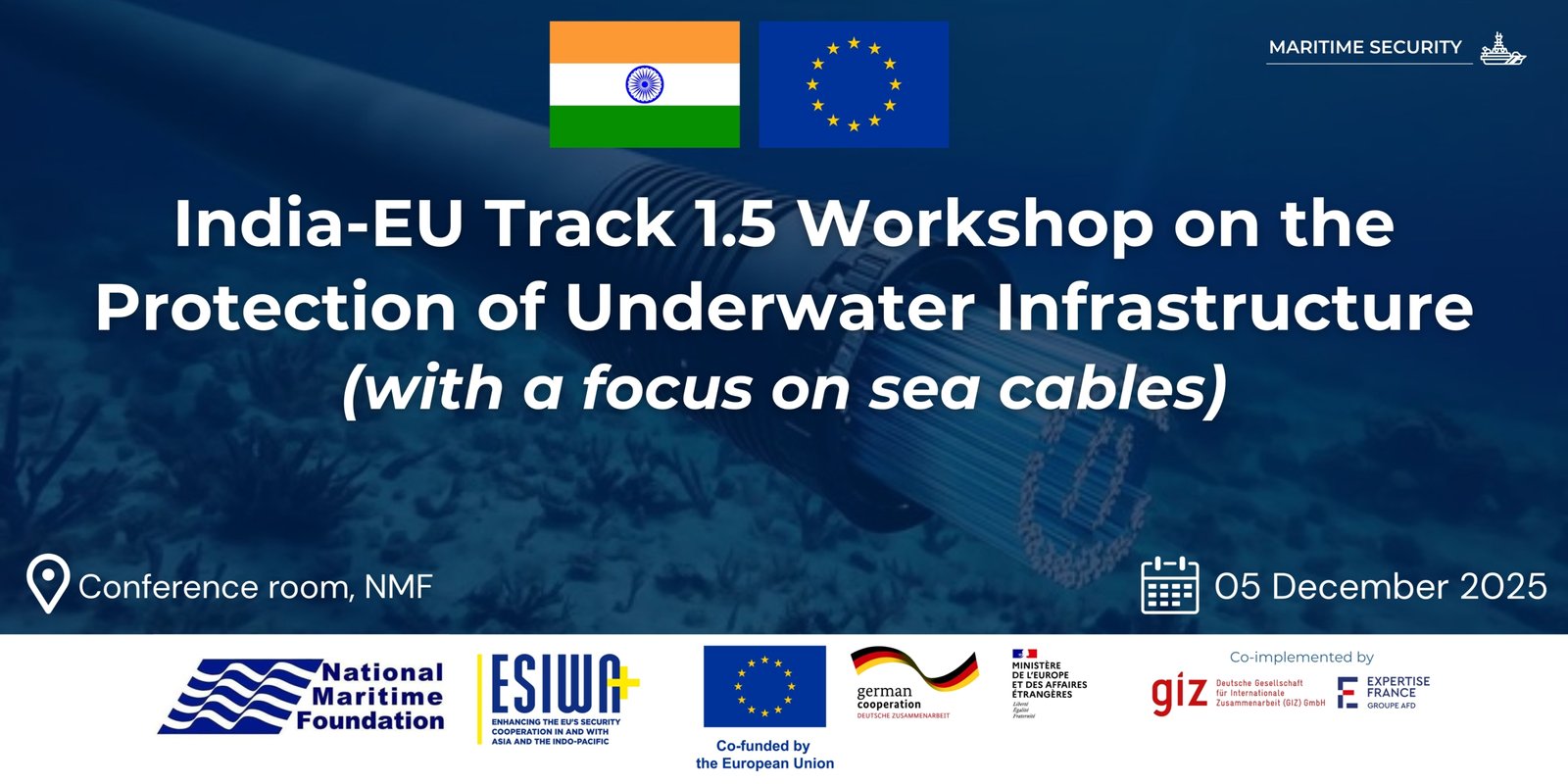
INDIA-EU TRACK 1.5 WORKSHOP ON THE PROTECTION OF UNDERWATER INFRASTRUCTURE (WITH A FOCUS ON SEA CABLES)
Concept Note
India–EU Track 1.5 Workshop on the Protection of Underwater Infrastructure (with a focus on sea cables)
The seabed today hosts a wide range of critical infrastructure, incorporating undersea telecommunication cables, energy pipelines carrying, inter alia, oil, gas, green hydrogen, etc., power cables, and a bewildering array of offshore installations for resource extraction. The rapid growth of such infrastructure fuelled by the significant demand for data, energy, power, and supercomputing facilities required to support modern and future economies has made them an important dimension in the global security construct. The impact of widespread disruption to undersea infrastructure especially communication cables is likely to be felt down to the individual due to disruptions in internet access, banking facilities, and payment interfaces. Increased reliance translates to increased vulnerability — coupled with an environment of heightened geopolitical contestation for greater access and control of resources, and diminishing mutual trust — which has become an attractive pressure-point for potential States and non-State competitors to exploit, in times of peace, tension, and conflict. The spate of undersea infrastructure damage incidents in Europe -particularly those in the Black and Baltic Sea – in the Red Sea, and in the Taiwan Strait bear testimony to the realisation of this threat. For Small Island Developing States (SIDS) of the Indian Ocean Region (IOR) like Mauritius, Maldives, Seychelles, and for Madagascar, these cables are an existential link to the world — any disruption to which can be devastating. The difficulty in attribution of act and intention makes this endeavour more attractive. This has made a predominantly commercial enterprise, a strategic and economic security concern for States.
Despite their strategic importance, undersea infrastructure is difficult to monitor and protect. Critical undersea infrastructure, particularly undersea cables transcend national boundaries; so do their associated vulnerabilities. Severe degradation of a country’s communications can take place without any disruptions being located close to the country’s territory. Vast ocean spaces, conflicting jurisdictions, unclear legal options and the uncertainty on the short term availability of a reliable repair ecosystem — all contribute to the challenges affecting their security and resilience.
The Indian Ocean, with India at its heart, is the interconnector facilitating East-West connectivity whether it be through maritime trade, communications, or energy flows. India forms a natural landing point for submarine cable projects connecting the global East to West, on both strategic and commercial grounds. In addition to the cables being important for data exchanges between Europe and India, landing points in India offer redundancy paths for the data interchanges to connect Europe beyond India in case of direct route failure. Additionally, since global communications follows the routes of International Shipping Lanes, India-Europe connectivity faces similar challenges of chokepoints and geopolitical turmoil along their path. Hence, India and Europe share common challenges, threats, and vulnerabilities, and consequently a common interest in ensuring their security and resilience. Therefore, common ends may be more effectively achieved by developing common ways and means.
India’s efforts in protection of critical undersea infrastructure includes accelerated efforts in operationalising repair vessels and commissioning them; enacting cable protection legislation and empowering enforcement agencies through the Telecommunications Act 2023 and expanding maritime surveillance to sub-sea level threats. In that regard concerted efforts have been made in enhancing regional Maritime Domain Awareness (MDA) architecture through mechanisms like the Information Fusion Centre – Indian Ocean Region (IFC-IOR), indigenous cable projects, and policy frameworks like MAHASAGAR and the Indo-Pacific Oceans Initiative (IPOI). India’s current trajectory reflects growing policy and regulatory commitment to the issue of undersea infrastructure protection that can be supplemented by efforts by friendly foreign countries.
The EU has also taken significant steps to protect critical undersea infrastructure in response to rising threats. It has strengthened regulation through the directive on Critical Entities Resilience (CER) and the updated directive on cybersecurity (NIS2). The EU has also launched a Cable Security Action Plan focusing on deterrence, prevention, detection, response and recovery. The EU has also endorsed a UN statement promoting resilience principles for undersea cables. The EU also contributes to MDA in the Indo Pacific through its project CRIMARIO III and its information sharing and coordination platform IORIS.
This workshop aims to advance India–EU Maritime dialogue and action on securing critical undersea infrastructure. It will aim to identify vulnerabilities, highlight best practices, and promote actionable solutions that integrate technology, policy, and cooperation. A special focus will be given to the role of Public-Private collaboration, regional legal frameworks, repair and maintenance ecosystems, and new strategic investments in cable connectivity for IOR island nations.
Objectives:
- Assess solutions to address key threats to undersea infrastructure in the Indian Ocean, including anthropogenic damage and natural disasters.
- Identify methods to ensure accountability and attribution to deter weaponisation of subsea vulnerabilities.
- Demarcate the role of public and private stakeholders in ensuring resilience.
- Draw lessons from Europe’s regulatory and technological frameworks and their application to the Indian Ocean Region.
- Identify infrastructural, institutional (both civilian and military), and legal mechanisms including repair capabilities to strengthen resilience.
- Explore strategic investment opportunities in new subsea cable projects, especially for SIDS.
For More Details on Programme: CLICK HERE


Leave a Reply
Want to join the discussion?Feel free to contribute!