
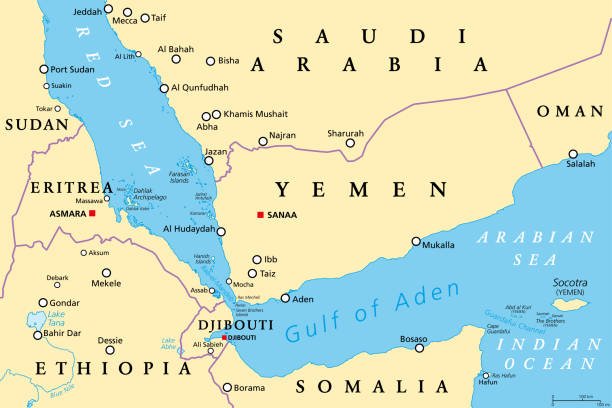
There has been substantial commentary on the Suez Canal and the Red Sea since 19 November 2023, the day the Houthi rebels seized[1] the MV Galaxy Leader, a British-owned, Japanese-operated ship in the southern Red Sea, which was carrying Israeli cargo. This seizure, as per the Houthis, was a reaction to the continuing Israeli aggression in Gaza. The Houthis had at that juncture, conveyed their intent to continue such actions, till such time Israel reigned in its military campaign. True to their word, the Houthis have, as per the US, undertaken 27 attacks[2] on merchant shipping till 11 January 2024.
Whilst the geography under discussion needs no elaboration from a strategic viewpoint, some important statistics and figures merit reiteration. The Suez Canal links the Red Sea with the Mediterranean Sea, in essence bridging Asia and East Africa with Europe and even North America. This makes it one of the most important arteries of commerce, one that carries 12% of global trade[3], including an estimated 30% of the world’s traded consumer goods. Further, the Red Sea chokepoints, the Suez Canal to the north and the Bab-el-Mandeb strait to the south, are critical for international oil and natural gas flows; accounting for about 12% of total seaborne traded oil and 8% of worldwide LNG trade[4], in the first half of 2023. It bears mention that in this period, oil exports from Russia accounted for 74% of Suez southbound oil traffic[5], most of which were headed for India and China. This, along with the fact that more than 20% of India’s exports pass through the Red Sea and the Suez, highlights the criticality of this route to India’s economy and wellbeing.
What, then, has been the implication of this ongoing crisis to trade and the global economy? These Houthi attacks have affected the interests of almost 50 nations, endangered the lives of crew[6], and have forced a large number of ships – 314 vessels between December 19 and 22 alone[7], to divert thousands of miles to avoid the Red Sea: resulting in extended transit times and increased costs. The alternative route, around the Cape of Good Hope, the one also taken by Vasco-Da-Gama, adds almost 4,000 nautical miles[8] and an additional 10 to 14 days to the journey. Egypt has reported a loss of 40% in Suez Canal revenues and a drop in ship-transit traffic by almost 30%[9]. Oil prices saw a rise of 2% on 12 January 2024. Spot container rates have risen almost 16%, and war risk premiums have increased from 0.1% in early December 2023 to the current range of 0.5% to 0.7%[10], significantly increasing freight costs. In India too, premiums have risen, with some companies stopping issuance of marine cover altogether. Most assessments indicate that India may see almost a US$ 30 Billion[11] reduction off its total exports in the current fiscal year due to the Red Sea Crisis. It is assessed that in addition to increased costs, shipping schedules have also become erratic, adversely affecting supply chains. Ultimately, the ongoing crisis may push shipping costs by up to 60% and insurance premiums by 20%, severely impacting trade[12]. All these would potentially filter through to the already stressed global economy, further boosting inflation, resulting in a negative impact on consumer markets worldwide.
The US, in consonance with multiple countries including the UK, Italy, France, Canada, Netherlands, Bahrain, Norway, Spain and Seychelles launched Operation PROSPERITY GUARDIAN[13] in the Red Sea, under the umbrella of the larger Combined Maritime Forces (CMF) and its Task Force 153, which focuses on security in the Red Sea; towards ensuring freedom of navigation and safeguarding marine trade. Warships of these countries have since then, shot down a substantial number of Houthi missiles and drones targeted at merchant ships traversing the area.
A Liberian-flagged vessel, the MV Chem Pluto, carrying 21 Indian crew members, was attacked by drones[14] on 23 December 2023, off the west coast of India, triggering security concerns. Another oil tanker, the MV Sai Baba, carrying 25 Indian crew members, which was on its way to India, also came under a suspected drone-strike in the southern Red Sea on the same day. While both these vessels were not India-flagged, these attacks, in essence, demonstrated the ripple effect of the ongoing crisis on India too. In addition to direct attacks, the Red Sea crisis is also leading to fears regarding a revival of piracy off Somalia and in the Gulf of Aden. The Malta-flagged vessel, the MV Ruen[15] was hijacked off the coast of Somalia on 14 December 2023. The Liberian-flagged MV Lila Norfolk[16] came under attack by pirates on the night of 04-05 January 2024. On both occasions, the Indian Navy immediately pressed into action it’s surveillance drones, maritime patrol aircraft and ships that were on mission-based deployment in the area. While an injured crew member was evacuated for medical treatment from the MV Ruen before the ship entered the territorial sea of Somalia, all the 20 crew members of the Lila Norfolk were rescued by Marine Commandos (MARCOS) of the Indian Navy.
In view of the fast-escalating situation, the Indian Navy, in keeping with its mandate of protecting and securing India’s maritime interests, has deployed a combination of assets comprising surveillance drones, Maritime Patrol Aircraft, and ships[17], including state-of-the-art guided-missile destroyers and frigates. This — possibly the largest Indian Navy deployment in the western Arabian Sea for maritime security operations, in recent times — demonstrates not only India’s concerns and interests related to the ongoing crisis, but also its resolve.
A question that immediately becomes germane to military/ naval protection of merchant shipping relates to the costs involved. The Houthis are, for the most part, using drones that have been described by the British forces in the area, as being of Iranian design. The US military’s Central Command has also said that in addition, the Houthis are also using anti-ship cruise- and ballistic missiles, both again being of Iranian design and origin. Some of the one-way attack drones being used cost as little as US$ 2000 apiece. The more sophisticated Iranian made Shahed-type drones cost about US$ 20,000 each[18]. The anti-ship missiles being used by the Houthis are understood to be in the price range of US$ 80,000 to about US$ 100,000 per unit[19]. On the other hand, the weapons being used to counter these on the US side are the SM-2 missile at US$ 2.1 million per unit, the Evolved Sea Sparrow Missile (ESSM) at US$ 1.7 million per unit, the Rolling Airframe Missile at US$ 905,000 per unit[20], and the 5-inch Air Burst shell at US$ 2500 per unit. The British and the French are using versions of the Principal Anti Air Missile System (PAAMS; called the Sea Viper by the British) comprising Aster 15 and Aster 30 missiles, each costing upwards of US$ 1.2 million per unit. According to a US Central Command Report, whilst repulsing one of the many Houthi attacks, 18 drones, two anti-ship cruise missiles and one anti-ship ballistic missile were shot down by a combination of two US guided-missile destroyers of the Arleigh Burke Class and one British Type-45 destroyer. Presuming that the sole British ship would have shot down one-third of these, the US price-tag for taking down the remainder of the targets amounts to about US$ 17 million[21]. The inordinately high cost, along with the severe depletion of missile interceptors, is clearly unsustainable, even in the short-term.
It is clear that involvement in a drawn-out conflict such as the current one in the Red Sea, would be prohibitive from both a cost as also a sustenance point of view. This further highlights the criticality of developing and fielding low-cost anti-air and anti-missile defence systems at the earliest.
The US and Britain have, on the 12th and 13th of January 2024, carried out strikes[22] against Houthi military targets, both from the air and the sea. In addition to the over-riding requirement of securing their trade and maritime security interests, these strikes have, quite probably, also been guided by the asymmetric differential in the cost of conflict for the two sides. The Houthis, supported by Iran, have the capacity to mass produce, and continue producing, low-cost and relatively unsophisticated drones and missiles. Clearly, the West had very little option other than to target Houthi ammunition dumps, weapon manufacturing sites and radar stations.
West Asia is already embroiled in a serious conflict — the Israel-Hamas war, which is likely to continue for some time to come. The world at large, and countries within West Asia in particular, are, at this juncture, extremely wary of the Israel-Hamas conflict spilling over and setting-off a larger, regional conflagration. This is obvious from the strident opposition to the US-led strikes from countries such as Oman[23] and Turkey[24], as also lack of enthusiasm from others such as Saudi Arabia[25] and the UAE, which have, in the past, faced the brunt of Houthi ire. Support from other partners of Op PROSPERITY GUARDIAN is also conspicuous by its absence.
Recent US statements have clearly identified and mentioned the Houthis being a proxy of Iran. Rather than taking a step back, Houthi statements after the US led strikes indicate a further hardening of their position and resolve to not only continue on their current line of action, but to also bring the US-led coalition combatants in the Red Sea, under the ambit of their attacks[26]. The question that arises, therefore, is whether the US, in extrapolation of its decision to conduct strikes on the Houthis, will also extend operations into Iran.
There is a very real probability that the ongoing crisis in the Red Sea could snowball into not only a larger regional conflict, but also one that has severe extra-regional connotations. Whether diplomacy alone can defuse the situation remains to be seen. India’s position as a preferred and trusted partner of both the West as also countries of the Middle East, including Iran, therefore assumes significance. In this context, the visit of the External Affairs Minister, Mr S Jaishankar, to Iran[27], is being viewed with both hope, and expectation.
*****
Endnotes
[1] “Security Council Report : Houthi Red Sea Attacks: Briefing and Consultations”, 02 January 2024. https://www.securitycouncilreport.org/whatsinblue/2024/01/houthi-red-sea-attacks-briefing-and-consultations.php.
[2] “Houthi attacks on shipping in Red Sea persist, U.S. and allies strike back”, Reuters, 12 January 2024. https://www.reuters.com/world/middle-east/houthi-attacks-shipping-red-sea-persist-us-allies-strike-back-2024-01-12/.
[3] Richard Partington, “What is the Red Sea crisis, and what does it mean for global trade?”, The Guardian, 03 January 2024. https://www.theguardian.com/world/2024/jan/03/what-is-the-red-sea-crisis-and-what-does-it-mean-for-global-trade.
[4] Candace Dunn, Justine Barden, “Red Sea chokepoints are critical for international oil and natural gas flows”, 04 December 2023. https://www.eia.gov/todayinenergy/detail.php?id=61025#:~:text=Southbound%20shipments%20through%20the%20Suez,up%20from%2030%25%20in%202021.
[5] Ibid.
[6] “ US provoked by ‘reckless’ Houthi attacks, Biden says on strikes”, Times of India, 13 Jan 24.
[7] Anirban Chowdhury, “Saving Suez: As Red Sea attacks threaten global trade, what it means for India”, The Economic Times, 24 December 2023. https://economictimes.indiatimes.com/industry/transportation/shipping-/-transport/saving-suez-canal-as-red-sea-attacks-threaten-global-trade-what-it-means-for-india/articleshow/106238746.cms?from=mdr
[8] Ibid. “Tankers divert from Red Sea after West strikes in Yemen”.
[9] Ibid. “ US Strikes may not be hitting home in Iran”.
[10] “ Red Sea disruptions ring India alarm bells”, Times of India, 13 Jan 24.
[11] “India’s exports may take a $30b hit on Red Sea threats”, Bloomberg, 09 January 2024. https://www.tbsnews.net/world/global-economy/indias-exports-may-take-30b-hit-red-sea-threats-771918
[12] “Red Sea crisis may push shipping cost by up to 60 pc, insurance premiums by 20 pc: GTRI”, The Economic Times, 06 January 2024. https://economictimes.indiatimes.com/industry/transportation/shipping-/-transport/red-sea-crisis-may-push-shipping-cost-by-up-to-60-pc-insurance-premiums-by-20-pc-gtri/articleshow/106594347.cms?from=mdr.
[13] “Statement from Secretary of Defense Lloyd J. Austin III on Ensuring Freedom of Navigation in the Red Sea”, US Dept of Defense, 18 December 2023. https://www.defense.gov/News/Releases/Release/Article/3621110/statement-from-secretary-of-defense-lloyd-j-austin-iii-on-ensuring-freedom-of-n/.
[14] “Closely monitoring: India on Houthi attacks in Red Sea”, The Indian Express, 13 January 2024. https://indianexpress.com/article/india/closely-monitoring-india-on-houthi-attacks-in-red-sea-9095694/.
[15] “Piracy Attack on MV Ruen In Central Arabian Sea”, Ministry of Defence, 21 December 2023. https://pib.gov.in/PressReleaseIframePage.aspx?PRID=1989252.
[16] Milan Sharma, “’Pirates ran away after…’: Navy Chief reveals how hijacked ship was rescued”, India Today, 06 January 2024. https://www.indiatoday.in/india/story/mv-lila-hijacked-in-arabian-sea-indian-navy-marcos-rescue-operation-red-sea-2485206-2024-01-06.
[17] Rajat Pandit, “Over 10 warships sent to deter pirates of the Arabian Sea”, Times of India, 09 January 2024. https://timesofindia.indiatimes.com/india/over-10-warships-sent-to-deter-pirates-of-the-arabian-sea/articleshow/106646794.cms?from=mdr.
[18] Lara Seligman, Matt Berg, “A $2M missile vs. a $2,000 drone: Pentagon worried over cost of Houthi attacks”, Politico, 20 December 2023. https://www.politico.com/news/2023/12/19/missile-drone-pentagon-houthi-attacks-iran-00132480.
[19] Eric Tegler, “Destroyers Shot Down 24 Houthi Missiles And Drones: That’ll Be $17 Million”, Forbes, 10 January 2024. https://www.forbes.com/sites/erictegler/2024/01/10/destroyers-shot-down-24-houthi-missiles–drones-thatll-be-17m/?sh=1ceaf8de6bdc.
[20] Kelley Beaucar Vlahos, “The Cost Of US Fighting Houthis In The Red Sea Just Went Up”, Quincyinst.Org, 19 December 2023. https://responsiblestatecraft.org/operation-prosperity-guardian/ #:~:text=According%20to%20the%20Missile%20Defense,which%20cost%20%24905%2C000%20in%202022.
[21] Eric Tegler, “Destroyers Shot Down 24 Houthi Missiles And Drones: That’ll Be $17 Million”, Forbes, 10 January 2024. https://www.forbes.com/sites/erictegler/2024/01/10/destroyers-shot-down-24-houthi-missiles–drones-thatll-be-17m/?sh=1ceaf8de6bdc.
[22] Jon Gambrell, Tara Copp, Aamer Madhani and Lolita C. Baldor, “US military strikes another Houthi-controlled site after warning ships to avoid parts of Red Sea”, AP News, 13 January 2024. https://apnews.com/article/yemen-houthis-us-ship-attacks-bombing-red-sea-iran-cc06d9186a00d1f22bea6b9c14dda12a.
[23] Ibrahim Khazin, “Oman condemns air strikes on Yemen”, 12 January 2024. https://www.aa.com.tr/en/middle-east/oman-condemns-air-strikes-on-yemen-by-friendly-countries-calls-for-de-escalation/3107278#.
[24] Patrick Wintour, Peter Beaumont, “US and UK intent on turning Red Sea into a bloodbath, says Turkey”, The Guardian, 12 January 2024. https://www.theguardian.com/world/2024/jan/12/hezbollah-and-iran-condemn-us-and-uk-strikes-against-houthis.
[25] Bill Faries, “Houthis Launch Barrage of Missiles and Drones in Latest Red Sea Attack”, Time, Bloomberg, 10 January 2024. https://time.com/6553746/houthis-missiles-launch-drones/.
[26] Elanor Watson, “Houthis vow to keep attacking ships in Red Sea after U.S., U.K. strikes target their weapons in Yemen”, CBS Newa, 12 January 2024. https://www.cbsnews.com/news/us-uk-strike-yemen-to-retaliate-houthi-attacks/.
[27] “Joint Press Statement by EAM, Dr. S. Jaishankar with Minister of Foreign Affairs of Iran”, Ministry of External Affairs, Government of India, Media Center, 15 January 2024. https://www.mea.gov.in/Speeches-Statements.

Leave a Reply
Want to join the discussion?Feel free to contribute!