
INDO-PACIFIC REGIONAL DIALOGUE 2024:
RESOURCE-GEOPOLITICS AND SECURITY IN THE INDO-PACIFIC
CONCEPT NOTE
SAGAR. Stretching from the coast of Africa to that of the Americas and from the southern coastline of Asia to that of Antarctica, the Indo-Pacific is a predominantly maritime space even though it does, of course, incorporate an important continental dimension as well. For India, the Indo-Pacific is not, in and of itself, a strategy. It is, instead, a strategic geography within which New Delhi formulates and executes a number of diverse strategies, all designed to promote regional economic and societal security and growth, thereby meaningfully contributing to peace, prosperity, and stability. Indeed, holistic maritime security and mutually reinforcing economic and societal growth throughout the Indo-Pacific is India’s desired end-state. Consequently, India’s maritime policy is encapsulated in the acronym SAGAR, which expands to “Security And Growth for All in the Region” and is also the Hindi word for ‘ocean’.
Indo-Pacific Oceans Initiative (IPOI). Providing first-order-specificity to SAGAR is the Indo-Pacific Oceans Initiative (IPOI), which was launched by India’s Prime Minister, Shri Narendra Modi, on 04 November 2019 at the 14th East Asia Summit in Bangkok. The IPOI comprises seven maritime lines-of-thrust and is, perhaps, best thought of as an intricate ‘web’ of seven deeply interconnected ‘spokes’, as the following conceptual-schematic depicts:
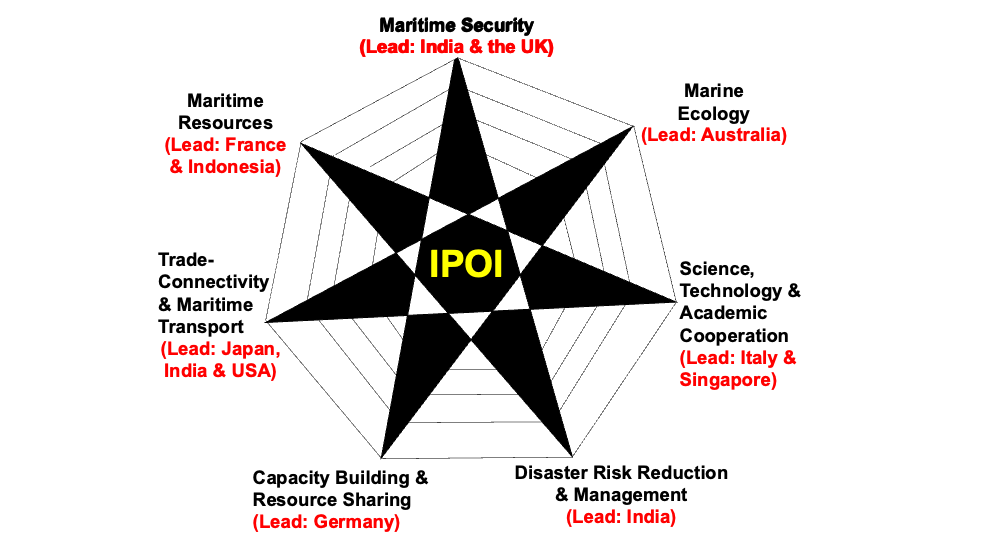
Indo-Pacific Regional Dialogue (IPRD). Fleshing-out the IPOI by providing second- and third-order-specificity is the aim of successive editions of the Indo-Pacific Regional Dialogue (IPRD). The IPRD is the Indian Navy’s annual, international, apex-level conference, and is the principal manifestation of the Navy’s outreach at the strategic level. As was enunciated by India’s honourable Finance Minister at the 2023 edition of this mega event, “the IPRD has, indeed, gained considerable traction and is fast establishing itself as the maritime supplement of the Raisina Dialogue”. Each successive edition of the IPRD is planned to sequentially focus upon the pillars/spokes of the IPOI web, one by one.
IPRD-2022. The 2022 edition of this conference (IPRD-2022) sought to familiarise the region’s strategic community with the IPOI (in its entirety) and sensitise it to the enormous potential of this initiative. While accepting the ubiquitous impact of regional geopolitics upon the IPOI, IPRD-2022 was successful in identifying a number of maritime best-practices and several way-ahead solutions that could be adopted regionwide.
IPRD-2023. An important pillar of the IPOI is “Trade, Connectivity, and Maritime Transport”. With its overarching theme being Geopolitical Impacts upon Indo-Pacific Maritime Trade and Connectivity, IPRD-2023 successfully injected a sense of realism in exploring the multiple dimensions of this pillar and identified regional policy-options and practices that could be proliferated across large swaths of the region.
IPRD-2024
In focusing upon Resource-Geopolitics and Security in the Indo-Pacific, the 2024 edition of the IPRD (IPRD-2024) will explore and elaborate upon the several dimensions of another vital pillar of the IPOI web, namely, “Marine Resources”.
It will concentrate upon those marine resources that are driving contemporary geopolitics and are likely to do so in the foreseeable future. There are several examples of such resources. One concerns the regional food-insecurity resulting from the dwindling of fish-stocks (partly due to climate change) and a sharp increase in illegal, unreported, and unregulated fishing, especially in oceanic areas beyond national jurisdiction. This challenge needs an urgent common response, especially when juxtaposed against burgeoning populations in the Indo-Pacific. Another is the geopolitical race for cobalt, lithium, nickel, and other hard-to-find minerals, as also rare earth elements (REE) such as tellurium and neodymium that are needed for the millions of batteries, solar panels, wind turbines, and other such renewable-energy devices that will be required if we are to successfully transition from fossil-fuels to renewable sources of electricity and other forms of energy. The demand for copper and steel is likewise expected to skyrocket. There are several decarbonisation pathways via which the global economy can limit warming to 1.5° C and there are corresponding technology-mixes involving different combinations of raw materials but all of them will involve fundamental shifts in the demand for different minerals. Solar photovoltaic plants, wind farms, and electric vehicles all require more minerals to build them than do their fossil-fuel based counterparts. These will create new sources of value while reducing others, thereby driving geopolitics within the Indo-Pacific. IPRD-2024 will endeavour to identify these mega trends and posit policy-options that could be pursued to advantage.
It is, of course, insufficient to focus solely upon geopolitics without reference to security. In maritime context, the relation between geopolitics and ‘holistic maritime security’ cannot be overemphasised, the latter term implying an all-encompassing state of affairs resulting in the freedom from threats emanating at-, from-, or through- the sea. The ongoing competition, and occasional confrontations, for exploration and exploitation of living and non-living resources of the oceans are illustrative of the security-dimension of resource-geopolitics. The IPRD 2024, consequently, will also endeavour to flesh out the Marine Resources spoke/pillar of the IPOI and explore its linkages-to and connectivities-with the Maritime Security spoke/pillar.
IPRD-2024 will also explore whether and how cooperation, collaboration, and comity might offer alternative pathways within resource-geopolitics. As things stand, competition, confrontation, and conflict over resources, are the defining geopolitical features of our age. The Indo-Pacific is no stranger to this geopolitical roil and is, even today, experiencing the effects of geopolitical turbulence. This turbulence could emanate from relatively distant areas in and around the Black Sea and Baltic Sea, or far more proximate ones in the vicinity of the Mediterranean Sea and the Red Sea, as also the East China Sea, the South China Sea, and the Philippine Sea. Indeed, manifestations of resource-geopolitics extend all the way down to the once idyllic island States of the South Pacific.
Since no meaningful solution pathway can be determined unless the contours of the problem are well understood, the deliberations of IPRD-2024 will seek — in the first instance — to sensitise the regional strategic community to the spatial and temporal dimensions and the various manifestations of the problems caused by resource-geopolitics in the Indo-Pacific. This will allow the eminent speakers and members of the audience alike to identify and advocate alternatives, even while acknowledging that the adoption of such alternatives is unlikely to be without its own challenges. For instance, the UN, and customary international law, have long recognised the world ocean (along with the atmosphere, Antarctica, and outer space) as a global common to be guided by the principle of the common heritage of humankind. And yet, some geopolitical actors, a few of which are to be found within the Indo-Pacific as well, are challenging the very foundations of consensually derived international law itself, especially the 1982 United Nations Convention on the Law of the Sea (UNCLOS). They hold that State power is the principal determinant of political and economic outcomes and that regional and international governance institutions and international law need only be paid lip service. This poses a serious challenge from which actors within the Indo-Pacific cannot and must not shy away if we are to discharge our common responsibilities in respect of inclusive societal development, inclusive economic development, environmental sustainability, and peace and security. IPRD 2024 will accordingly dilate upon how best the region as a whole should confront such challenges.
Conclusion. In sum, in its exploration and examination of resource-geopolitics within the Indo-Pacific, IPRD-2024 will encompass wide-ranging and multifaceted discussions that are not content with a mere statement or restatement of the problem set, but rather, upon the identification of regional solutions that could guide policy-formulation as well as policy-execution at national, sub-regional, and pan-regional levels.