ENTRY OF THE DRAGON - CHINA LOOKS TO THE WEST
Date : 08-08-2019
Picture:
Google Images
Author: Aastha Vohra*
Hailed as a
civilizational power at its roots, China, in its ongoing efforts to market its Belt
and Road Initiative (BRI), is making changes around the world. The ambitious BRI was introduced by President
Xi Jinping in 2013 and draws its inspiration from the Silk Road of the Third Century
CE, which had put China at the centre of the world’s East-West trade routes and
brought the Middle Kingdom power, prestige and prosperity. The BRI is essentially a geostrategy aimed at
the attainment of China’s economic objectives — principally those of generating
and sustaining economic growth and development through the building of
infrastructure, transportation projects and energy sustenance. It comprises two broad initiatives, viz., the
‘Silk Road Economic Belt’, and the ‘21st Century Maritime Silk
Route’. Aimed at global dominance in
what is being called the ‘Chinese Marshall Plan’, its figures of investments ($
1 Tn) are greater than those of the Marshall Plan (which financed the reconstruction
of Europe), and, unlike the USA and Europe, China has 71 countries party to its
project. That is not to say that Europe
is not important to China or to the BRI. According to Politico, “A survey by the consultancy EY said the Chinese spent €75 billion
in European acquisitions and investments in 2016. Another study showed that China invested as much in Europe in
2016 as it did in the 10 previous years combined.”
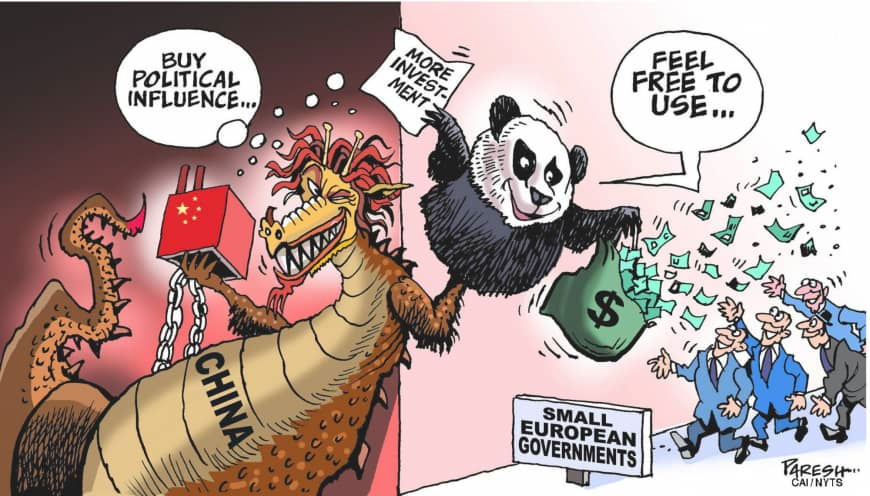
However, in a ‘divide-and-deal' pattern that is very similar to that followed
by Beijing vis-à-vis ASEAN, China has sought to fracture the EU geopolitically,
even while offering economic advantages to the different segments of the Union.
Thus, in order to contextualise the BRI to Central and Eastern Europe
(CEE), Beijing has introduced a formalised structure of trade and economic
cooperation between China and a group of CEE countries, which is also
referred-to as the ‘17+1’ Group. The ‘17’ comprise Albania,
Bosnia and Herzegovina, Bulgaria, Croatia, the Czech Republic, Estonia, Greece,
Hungary, Latvia, Lithuania, Macedonia, Montenegro, Poland, Romania, Serbia, Slovakia
and Slovenia, while the ‘1’ refers to China.
These countries embraced the project in the wake of the 2008 global
financial crisis and have benefited from it, albeit along a trajectory defined
by the ‘law of diminishing returns’. China has made much of the notion that it values
their collective geostrategic position as a bridgehead to the EU market and a
crucial transit corridor for the BRI. This
is, of course, a very clever move, as it has provided China with significant
economic access-to and acceptability-in Europe, hence effectively overcoming
the tyranny of distance between the East and the West. As such, the ’17 + 1’ Group is viewed by
China as an important mechanism by means of which it is able to push its geoeconomic
agenda in terms of the BRI.
On the one hand, as many as 11 of these 17 countries are
simultaneously members of the European Union (EU). On the other, their relationship with other
EU member-states has been a prickly one.
In attitudinal terms, the 17 CEE Countries have far more in common with
one another than they do with Western European States. As an example, the Visegrád Group, consisting
of Hungary, Czech Republic, Slovakia and Poland, is a political union with a
shared history. Its constituent States are all members of the EU but, frequently
demonstrate significant and overt Euroscepticism. Not surprisingly, then, interactions between the
Visegrád Group and Western European members of the EU are characterised by considerable
exasperation. It is, therefore, quite
possible that the success of the ’17 + 1’ Group could concomitantly cause a further
fracturing of the EU, causing not only a decline in the present centrality of
Western European countries within the EU, but also a reduction in the
effectiveness of the European Union as a credible global force. This is of great significance to countries of
the Indo-Pacific, given that the EU as a whole is currently striving to
position itself as a meaningful maritime-security player within this region.
Turning from the ‘17’ to the ‘1’, the entry of a global
and assertive (if not aggressive) giant such as China into any given segment of
the European region, in and of itself threatens the unity of the EU and,
possibly, even threatens the integration of Europe itself, especially in the
wake of ‘Brexit'. For example, the refusal by Athens to criticize human rights violation under Xi Jinping
in June 2017 led to the
undermining of the EU’s efforts to support Human Rights. The action (or rather,
‘the inaction’) by Greece was, of course, the result of the huge investments that
had been made by China in the beleaguered Greek economy. More recently, on 23 March 2019, Italy agreed
to join the BRI, becoming one of the first developed countries to do so. As part of the 29 deals signed during Xi Jin
Ping’s visit to Rome, Italy will provide access to the port of Trieste, thereby
enable multimodal routes to be established by China into Central and Eastern
Europe.
It has not, however, been all smooth sailing for the ’17
+ 1’ Group either. Although the ’17 +
1’ has been projected as a manifestation of South-South cooperation in an
increasingly multilateral world, its scope has largely been limited to highly
competitive bilateral trade. While
the balance-of-trade between China and the remaining countries of the CEEC remained
roughly equal in the initial years of the initiative, in more recent times, there
has been a steady increase in exports from China to the CEE countries, but not
the other way around, thanks to progressively more severe trade barriers being
put in place by China for exports into the Middle Kingdom. According to the European Commission’s Market
Database, China, with 25 barriers in place, ranks second after Russia in terms of
the imposition of trade restrictions.
Likewise, there has been a pushback from the EU, its
internal dissensions notwithstanding. Have
27 of 28 members of the European Union signed a document denouncing the BRI for
hampering free trade and for giving undue preference to Chinese companies. Hungary,
under the leadership of Viktor Orban, was the sole exception. Once again, this was a political effect
stemming from an economic consideration, where China agreed to tightly weave Hungary’s ‘National Development Strategy’ into the BRI. The five contracts signed by
Hungarian enterprises in June 2016 within the fields of light industry, wine
exports, meat exports, electronics and IT, have opened up several opportunities
for further cooperation between Hungary and China.
At a more generic level, there is increasing evidence of
a pushback against the BRI. This takes
many forms. For one thing, there is a
sharply increased focus on the ‘Indo-Pacific’ by the United States of America, which
plans to invest some US$ 113 million by way of financial support for
countries of this region. Similarly, there is a marked improvement in the
bilateral relationship between the USA and India, both of which are the only major
countries firmly opposing the BRI. The emphasis in this article on Europe
notwithstanding, countries in other parts of the world, too, have begun questioning
the ‘no-strings attached’ policies of China.
These include Sri Lanka,
Malaysia, Indonesia, Bangladesh, Tanzania, and even, to some degree, Pakistan.
Will the European bastion finally fall to the Chinese
geopolitical assault? Will the EU
remain credible within Europe itself, and, even if it does, will it, weakened
as it is by Chinese-driven wedges such as the ’17 + 1’ construct, be able to
project credibility and seriousness of intent in the far more distant waters of
the Indo-Pacific? These are questions
that demand the most careful examination by that other resurgent power of
global significance — India.
**********************************
*Aastha Vohra is a
Research Associate at the National Maritime Foundation (NMF), New Delhi. The
views expressed here are her own and do not reflect the position of the NMF. She
can be reached at researchassociate4.nmf@gmail.com
and aastha.vohra96@gmail.com
Department: Making Waves