REINVIGORATING INDIA-MALDIVES MARITIME COOPERATION AMIDST THE GROWING SINO-INDO STRATEGIC COMPETITION IN THE INDIAN OCEAN REGION
Date : 13-09-2019
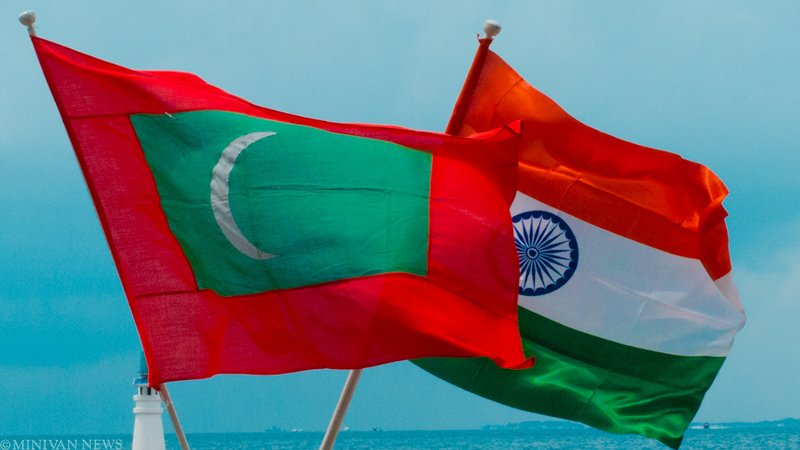
Author: Ritika V. Kapoor
Several Chinese analysts have, while asserting that
‘China is not jostling with India for strategic influence in the region’,
frequently remarked that India cannot, on its own, assure security in the Indian
Ocean Region (IOR). While the former
assertion may seem paradoxical in view of China’s assertive execution of her
geostrategies in India’s backyard, both countries are, in fact, involved in a
game of power balance — opportunistically aiming to boost their respective clout
in the area by directing their foreign policies towards the Small Island Developing
States (SIDS) of the region. An important
example, and undoubtedly one that needs to be extensively studied from an
Indian perspective, is Maldives. The
following paragraphs accordingly encapsulate India’s renewed efforts at bracing
her maritime relationship with this archipelagic country. The urgency of these efforts stems from the
realisation in Indian governmental circles that Maldives, not too long ago, was
almost lost to China’s proactive initiatives. Fortunately for New Delhi, the new leadership
of Maldives seems quite open to re-engaging with India under Modi.
Prime Minister Narendra Modi’s recent
visit to the island nation also constituted the Indian leader’s first overseas
visit after assuming his government’s second term in office. It resulted in the two neighbours signing a
variety of Memorandums of Understanding (MoUs). While this may be attributed to India’s
cognizance of the importance of her engagements with her neighbours within the
maritime domain, it is obvious that such actions also form part of India’s
wider response-strategy to the growing geoeconomic and geopolitical interests
of China within the IOR. In the Maldives,
in particular, the Chinese have been involved in a number of infrastructure-development
projects, including the $210 million China-Maldives
Friendship Bridge, while also considering the strategic island-State to
be a key component of its Belt and Road Initiative (BRI).
Returning to the subject of India’s effort
to reinvigorate its ties with the Government of Maldives, the two countries have
been eyeing a number of areas of mutual interest in which to develop the full potential
of their partnership. One such area is
tourism.
In 2018, India accounted for 6.1 per
cent of the total Foreign Tourist Arrivals (FTAs) into the Maldives. While this
may not appear very impressive as a percentage value, it nevertheless translated
into some 90,540 Indian tourists. In
March 2019, there were 36,116 Indian tourist-arrivals to the island nation, demonstrating
an impressive annual growth of 86% in comparison with the figures for March 2018.
However, the corresponding figure for
India is much lower – only some 66,150 Maldivians travelled to India in 2017 against 83,019 Indian tourists who visited the Maldives in that same
year. This interesting asymmetry raises three
questions that have considerable significance for the Government of India: (i) Does
India have enough to attract and excite Maldivian tourists? (ii) If the answer
to the first question is in the affirmative, then in which specific areas does the
Indian tourism industry fall short of Maldivian expectations? (iii) Can
maritime tourism offer a mitigating strategy to more evenly balance the FTAs?
The third question is of particular
interest as it addresses a hitherto unexploited area. Both nations have been actively looking at
ways to boost maritime tourism and they recently signed an MoU to develop passenger
and cargo ferry services from Male and Kulhudhuffushi, in the Maldives, to
Kochi, in India. The two governments hope that this service, which seeks to
actively promote not just bilateral trade but people-to-people contacts as
well, will provide a win-win situation that both nations can build upon.
It is important, however, to remember that
this joint proposal for the establishment of a ferry service has its own share
of bottlenecks. First of all, even
though earnings from tourism account for 80 per cent of the GDP of the Maldives,
connectivity is predominantly provided by air and by large cruise-liners. Despite air travel being an expensive mode of
transportation, it is, nevertheless, the preferred one, largely because of the
savings in time that are effected. However, if middle class tourists are
targeted, it is possible to develop relatively cheap but speedy maritime transport
for travel both within the island nation (between, say, Male and
Kulhudhuffushi), as also between India and the Maldives. This should not be seen as a means of
‘poaching’ tourists away from air travel, but rather, as a means of attracting
additional numbers of more cost-conscious tourists who seek to optimise their
spending. On the one hand, the establishment
of this ferry service forms part of the Maldivian Government’s plan of
attracting middle-income households in India — some 23.6 million people — who currently, according to the Global Wealth
Report 2015 of Credit Suisse, represent a significant 3 per cent of the global
middle class. On the other hand, the
ferry service must also attract Maldivian tourists to India, with Kochi acting
not only as an attractive tourist-destination in and of itself, but also as a
gateway to a wider tourism circuit within India.
A second risk is that the project could
fall prey to political opportunism. An earlier
example of this sort is to be found in the fate that befell the Scotia Prince,
a private luxury vessel, which operated between Colombo in Sri Lanka and
Tuticorin in India, and was abruptly suspended for an indefinite period of
time, after just six months of its commencement of operations. Political short-sightedness and greed were
largely to blame for the inability of the project to develop and sustain
financial viability. Mitigating strategies, emanating from a brutally honest
appraisal of the political causes underpinning the failure of this earlier
venture, will clearly need to be put in place so that this distressing
experience is not repeated.
India’s
current budget allocates a generous Rs.
57.6 million in aid for the Maldives, reflecting a very significant
increase
(of some Rs.
44 million) over the last
financial year’s allocation. Such an increase in the allocation to India’s
neighbouring island states is in consonance with New Delhi’s 'Neighbourhood
First' policy. This aid is expected to include projects such as the afore-discussed
Kochi-Kulhuddhufushi-Male passenger-cum-cargo ferry service, a coastal-radar
surveillance-system, training facilities for the Maldives National Defence
Force (MNDF), etc.
Another area of mutually beneficial
cooperation between India and the Maldives is in terms of holistic maritime
security. In 2013, India, Maldives, and Sri Lanka, signed a tripartite
agreement on maritime cooperation, designed to secure the sea routes in the IOR.
Interestingly, this pact was entered-into, at a time when the agreement for
handing over the control of Gwadar Port from Pakistan to China had been
announced. Three security dialogues at the level of the respective National
Security Advisers (NSA) have been held between the three parties (Male – 2011,
Colombo – 2013, and New Delhi – 2014). Further talks were precluded by major
political changes in the Maldives (2013) and Sri Lanka (2015), causing a
discernible loss of momentum in these security consultations. This
notwithstanding, the upsurge in bilateral cooperation between India and
Maldives, as also between India and Sri Lanka, will generate fresh
opportunities for the revival of mutually beneficial cooperation on security
matters. The centrality and urgency of
security-cooperation was underscored by the horrific Easter bombings in Sri
Lanka. There is little doubt that over
the longer term, these opportunities must be availed so as to enable the
formulation of a coherent and acceptable geostrategy to manage the inevitable
increase in Chinese presence in the IOR. The Yameen regime had proactively permitted
the Chinese to build a Maritime
Observatory Station (Joint Ocean Observation Station) in Makunudhoo,
which is situated very close to India's own naval and military facilities in
the Lakshadweep Islands. Fortunately, the
Maldives, under Solih’s presidency, has decided to scrap this Chinese
agreement of establishing the observation station.
Indeed,
the optimal manner in which to manage China within the IOR is another area of
common interest. How best to cope with
the hugely expanded Chinese influence in the region is a question of seminal
importance to the Maldives, particularly with President Solih looking for ways to
finesse what increasingly appears to be yet another Chinese debt-trap, by
finding alternative sources of finance to repay the massive three
billion dollars-worth
of Chinese debt.
In conclusion, the Modi-led ‘NDA 2.0’ is
strongly promoting twin thrust-lines for a more effective Indian foreign policy
– ‘Neighbourhood First’ and ‘Act East’. Both
seek to advance India’s own interests, especially (but not exclusively) within
the maritime domain, while enabling the formulation and execution of
risk-management and risk-mitigation strategies designed to optimally manage the
expanding Chinese foothold in the Indian Ocean Region. An important facet of
these thrust-lines is the reinvigorating of India’s traditionally strong ties
with the Maldives. Indian initiatives in
this regard come not a moment too soon.
****************************
*Ritika V. Kapoor is a Research
Associate at National Maritime Foundation (NMF), New Delhi. The views expressed
here are her own and do not reflect the position of the NMF. She can be reached
at
Department:Experts View